







Net price: €131.58
Description
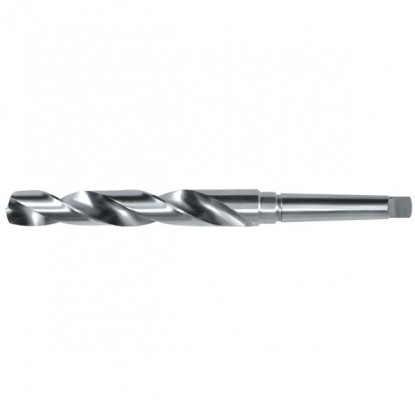
Twist drill with Morse taper shank
| TECHNICAL DATA | |
|---|---|
| Diameter | Ø53 NWKc HSS |
| Standard | DIN 345 |
| Drill type | NWKc — twist drill with taper shank |
| Material | HSS (high-speed steel) |
| Overall length l1 | 412 mm |
| Flute length l2 | 225 mm |
| Morse taper | MT5 |
| Point angle | 118° |
| Diameter tolerance | h8 |
| Cutting direction | Right-hand |
Product description and key benefits
The Ø53 mm HSS twist drill with an MT5 Morse taper is designed for use on machine tools with a rigid construction and sufficient drive power. At diameters above 50 mm, the chisel edge generates a significant portion of the axial force — pilot holes reduce this effect and improve tool guidance stability. The Ø53 Morse taper drill is used in machinery plants, shipyards, and valve and fitting factories.
The Ø53 Morse taper drill is used in heavy machinery manufacturing plants, ship repair yards, and industrial valve and fitting factories. Typical applications include holes for mechanical anchors in foundation plates, holes in gearbox bearing end shields, and bores for guide bushings. Hole tolerance class H12 (Ø53.000–Ø53.300 mm); H7 and tighter fits are achieved by boring.
Dimension table for all Morse tapers MT0–MT6
| Taper | Diameter D [mm] | Length [mm] |
|---|---|---|
| MT0 | 9.045 | 49.8 |
| MT1 | 12.065 | 53.5 |
| MT2 | 17.780 | 64.0 |
| MT3 | 23.825 | 80.5 |
| MT4 | 31.267 | 117.5 |
| MT5 | 44.399 | 149.5 |
| MT6 | 63.348 | 210.0 |
REDUCTION SLEEVES COMPATIBLE WITH THE Ø53 MM DRILL BIT:
| ✓ | MT5 → MT6 — for a spindle with an MT6 socket |
| ✓ | MT5 → MT4 — not recommended (socket capacity below the operating load) |
| ✓ | MT5 drill drift — for removing the drill bit from the spindle |
Recommended machining conditions for a diameter of Ø53 mm
| ISO symbol | Workpiece material | Vc [m/min] | f [mm/rev] | n [rpm] | Vf [mm/min] |
|---|---|---|---|---|---|
| P Steel | Structural steel up to 900 N/mm² | 11÷20 | 0.32 | 66÷120 | 21÷38 |
| K Cast iron | Gray cast iron GG20–GG30 | 13÷16 | 0.32 | 78÷96 | 25÷31 |
| N Copper and Al alloys | Cu, CuZn, Al, and alloys | 25÷28 | 0.40÷0.50 | 150÷168 | 60÷84 |
The Ø53 mm drill should not be used without a pilot hole. Drill a pilot hole using a Ø20–25 mm drill — this reduces axial force by 40–50% and eliminates engagement of the chisel edge responsible for vibration. At depths greater than 106 mm (2×D), use peck drilling with retraction every 30–40 mm and ample coolant (min. 8% emulsion, 8 l/min).
Range of workpiece materials and application limitations
Yes — it is required. A Ø20–25 mm pilot hole eliminates cutting by the chisel edge, which at a diameter of 53 mm generates 60–70% of the total axial force and severe vibration.
1) Drill a Ø20–25 mm pilot hole. 2) Check runout in the spindle (maximum 0.03 mm). 3) Clamp the workpiece rigidly. 4) Use power feed — manual feed causes uneven pressure and resonance.
Yes — gray cast iron (GG20–GG30) and ductile cast iron (GGG40) are well suited to HSS drills. Short, brittle chips are easier to evacuate from the flutes than steel chips. Dry drilling with a compressed air blast is possible.

Reference: 1187 In stock < 10 items
€55.03 brutto
No customer reviews for the moment.
All orders are delivered by courier company GLS. For orders exceeding 369 PLN gross shipping is FREE
| Courier GLS | Przelew24 / Prepayment | 14,76 zł gross | Delivery time 1 working day |
| Courier GLS | Cash on delivery | 17,26 zł gross | Lead time 1 working day |
This website uses its own and third-party cookies to improve our services and show you advertising related to your preferences by analyzing your browsing habits. To give your consent to its use, press the Accept button.


