





- 98% satisfied customers
- 72h delivery
- 30 dni na zwrot
navigate_next
navigate_next
navigate_next

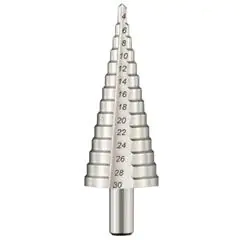
Tapered Drill 6-30 No. 2 HSS
Bucovice Bucovice
0000003616
€43.70 tax inc.
Net price: €35.53
Instant Shipping
W magazynie: 10-100 szt.
Description
Diameter range6–30 mm
Steps13 in 2 mm increments
MaterialHSS
Steel sheetup to 4 mm
6-30 mm step drill – for metal, HSS
Technical data and dimensions – 13 steps in 2 mm increments, 10 mm shank
| Technical data | |
|---|---|
| Diameter range | 6–30 mm |
| Steps | 13, in 2 mm increments: 6, 8, 10, 12, 14, 16, 18, 20, 22, 24, 26, 28, 30 mm |
| Flute | straight |
| Shank diameter d | 10 mm, straight |
| Overall length L | 100 mm |
| Material | HSS (high-speed steel) |
| Steel, cast iron, bronze | 0.3–4 mm sheet |
| Aluminum, brass, copper | 0.3–6 mm sheet |
| Plastics | up to 10 mm |
| Manufacturer | Bučovice Tools, Czech Republic |

6-30 mm step drill drills holes from 6 to 30 mm in sheet metal with a single tool. It has 13 steps in 2 mm increments. Each step enlarges the hole by 2 mm and is guided by the hole made by the previous step. This keeps successive diameters coaxial without changing drills. Secure the 10 mm straight shank in a drill chuck.
The drawing shows the diameters of all steps, the shank and the overall length of 100 mm. The outline of the steps forms a cone, hence the name. The same tool is also called a step drill or Christmas tree drill. The manufacturer, the Czech company Bučovice Tools, calls it a straight-flute step drill. The flute runs along all the steps, and its edge cuts at each one. The drill is made of uncoated high-speed steel (HSS).
Applications – sheet metal, profiles and deburring
Three uses for one drill
The drill is useful for metalworking, installation, and electrical work. It performs best in thin materials: sheet metal, panels, and section walls. In these applications, a large twist drill can easily tear the sheet and leave a ragged edge. The steps cut successively in radial increments of 1 mm, preventing the sheet from tearing.
Hole in thin sheet metal
Start drilling the enclosure or panel sheet metal with the smallest 6 mm step. The drill advances through successive steps until the hole reaches the required diameter. You can drill through steel up to 4 mm thick, and aluminum and copper up to 6 mm thick. The hole edge remains even.
Deburring the hole edge
Drilling leaves a burr on the hole edge. Lightly touch the edge with the next larger step. The step removes the burr and produces a small chamfer. This lets you deburr holes from 6 to 28 mm with the same drill.
Hole in a section or tube
The drill also drills through hollow section walls and thin-walled tubing. The same thickness limits apply as for sheet metal: up to 4 mm for steel and up to 6 mm for aluminum. Select the hole diameter by the step, without changing tools.
Drilling sheet metal step by step
Thickness, speed, oil, and deburring
Four steps take you from measuring the sheet to a finished, deburred hole. Thicknesses, speeds, and cooling recommendations come from the Bučovice Tools catalog for this drill.
1
Check the sheet thickness
You can drill through steel, cast iron, and bronze up to 4 mm thick. Aluminum, brass, and copper up to 6 mm, and plastics up to 10 mm. These values are specified in the manufacturer's catalog.
2
Set the speed and apply oil
Select the speed for the largest step that will pass through the sheet. For steel and the 30 mm step, this is 150 rpm. For smaller steps, the manufacturer permits up to 600 rpm. Apply oil to the drilling location.
3
Drill to the required step
Count the steps from the tip: 6, 8, 10, 12 mm. You have a 12 mm hole when the fourth step passes through the sheet. Each step enlarges the hole by 2 mm, without changing drills.
✓
Deburr the edge
Lightly touch the hole edge with the next larger step. The transition between steps removes the burr and leaves a small chamfer. You can deburr holes from 6 to 28 mm in the same way. No separate deburring tool is needed.
Speeds and cooling – steel, cast iron, aluminum, plastics
Values from the Bučovice Tools catalog for the 6–30 mm HSS drill
The manufacturer specifies a speed range. The higher value applies to the smallest 6 mm step, and the lower value to the largest 30 mm step. For intermediate steps, set a speed within the range, closer to the lower value.
| Workpiece material | Speed: step 6 mm → 30 mm [rpm] | Thickness [mm] | Coolant supply |
|---|---|---|---|
| P Non-alloy structural steel up to 500 MPa | 600 → 150 | 0.3–4 | oil |
| P Alloy structural steel up to 800 MPa | 500 → 100 | 0.3–4 | oil |
| K Ductile and malleable cast iron | 500 → 100 | 0.3–4 | oil |
| N Bronze, short-chipping brass | 500 → 100 | 0.3–4 | oil |
| N Aluminum, long-chipping brass, copper | 1200 → 400 | 0.3–6 | oil |
| N Plastics | 700 → 200 | up to 10 | water or oil |
Calculation: why larger steps require lower speeds
Cutting speed is the speed at which the cutting edge moves across the material. Speed = 3.14 × step diameter 30 mm × rotational speed 150 rpm ÷ 1000 ≈ 14.1 m/min. At the 6 mm step and 600 rpm, the result is approximately 11.3 m/min. A larger step has a greater circumference, so at the same rotational speed the cutting edge would move faster and overheat. This is why you set the speed for the largest step that will pass through the sheet.
▲
Stainless and hardened steel – no manufacturer data
Bučovice Tools does not specify speeds or thicknesses for stainless steel, hardened steels, high-speed steels, or heat-resistant alloys. Do not machine these materials with this drill. The manufacturer permits gray cast iron, copper, and alloy tool steel with restrictions.
6-30 mm step drill HSS drills 13 diameters in sheet metal, from 6 to 30 mm in 2 mm increments. It drills through steel up to 4 mm thick, aluminum, brass, and copper up to 6 mm, and plastics up to 10 mm. Successive steps enlarge the hole concentrically and deburr its edge. The 10 mm straight shank and 100 mm length fit a drill chuck.
Questions about the 6-30 mm step drill
Thickness, speeds, materials
Steel, cast iron, and bronze from 0.3 to 4 mm. Aluminum, long-chipping brass, and copper from 0.3 to 6 mm. Plastics up to 10 mm. These are the ranges specified in the Bučovice Tools catalog.
For structural steel, from 600 rpm at the 6 mm step to 150 rpm at the 30 mm step. For aluminum, from 1200 to 400 rpm. Set the speed for the largest step that will pass through the material.
For structural and tool steels up to 900 MPa, cast steel, ductile cast iron, and malleable cast iron. Also for bronze, brass, aluminum, zinc, and plastics. The manufacturer permits gray cast iron and copper with restrictions.
Reviews
No customer reviews for the moment.
Shipping
All orders are delivered by courier company GLS. For orders exceeding 369 PLN gross shipping is FREE
| Courier GLS | Przelew24 / Prepayment | 14,76 zł gross | Delivery time 1 working day |
| Courier GLS | Cash on delivery | 17,26 zł gross | Lead time 1 working day |
Recommended for you
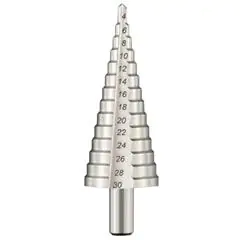
Tapered Drill 6-30 No. 2 HSS Podgląd zdjęć produktu
01 / 01
Powiększenie 100%
Użyj strzałek, aby zmieniać zdjęcia. Powiększaj przyciskami albo gestem szczypania. Zamknij galerię klawiszem Escape.
This website uses its own and third-party cookies to improve our services and show you advertising related to your preferences by analyzing your browsing habits. To give your consent to its use, press the Accept button.
Cookie preferences
Functional cookiesTechnical
Functional cookies are strictly necessary to provide the services of the shop, as well as for its proper functioning, so it is not possible to refuse their use. They allow the user to browse through our website and use the different options or services that exist on it.
Advertising Cookies
These are cookies that collect information about the advertisements shown to users of the website. They can be anonymous, if they only collect information about the advertising spaces shown without identifying the user, or personalised, if they collect personal information about the user of the shop by a third party, for the personalisation of these advertising spaces.
Analytics cookies
Collect information about the user's browsing experience in the shop, usually anonymously, although sometimes they also allow the user to be uniquely and unequivocally identified in order to obtain reports on the user's interests in the products or services offered by the shop.