







Net price: €19.74
Description
| Technical data | |
|---|---|
| Nominal diameter d1 mm | M13 |
| Thread pitch P mm | 1.25 mm |
| Overall length l1 | 71 mm |
| Flute length l2 | 22 mm |
| Shank diameter d2 | 11 mm |
| Square drive size a | 9 mm |
| Tap drill diameter | 11.8 mm |
| Thread angle G | 60° |
| Tap tolerance | ISO2 6H |

Division of work in the 1–2 set
The M13x1.25 thread is cut into the wall of a hole with a diameter of 11.8 mm. The thread groove extends 0.6 mm into the wall. A single tap would have to cut the entire groove at once, requiring substantial hand torque and risking breakage. The set divides this work into two passes.
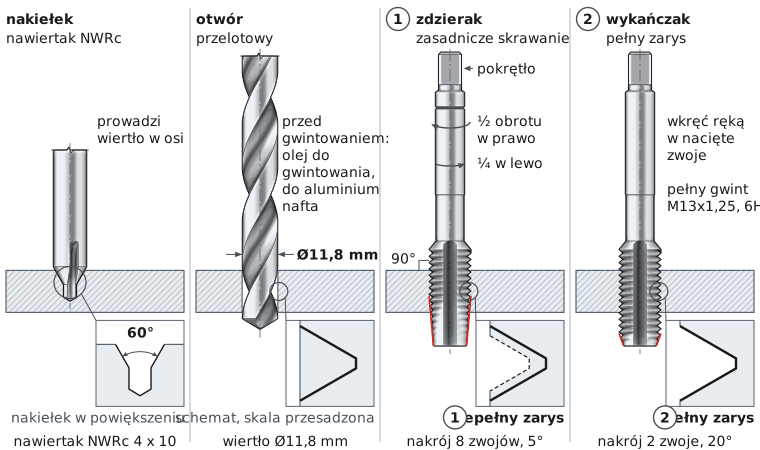
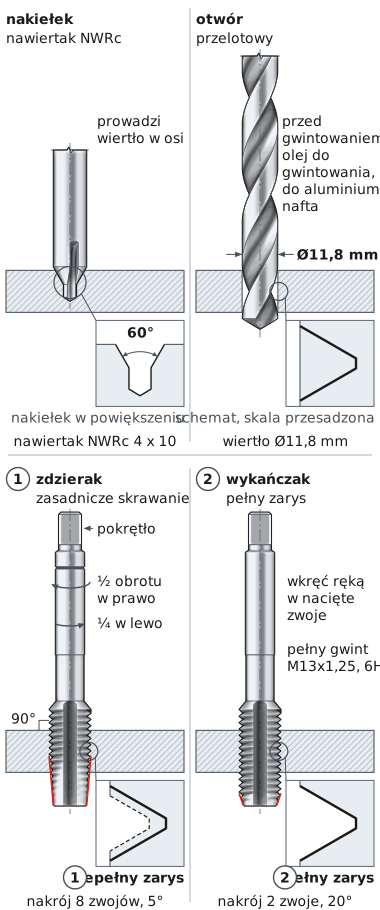
The drawing shows the entire set in operation. Both taps have the same shank and the same length. They differ in their chamfer, the tapered tip: No. 1 has a chamfer spanning 8 threads, while No. 2 spans only 2 threads. The detail windows at the hole wall show how the thread groove deepens after each tap.
| Tap | Chamfer | Chamfer angle | Material removed | How it works in the hole |
|---|---|---|---|---|
| No. 1 – roughing tap | long, 8 threads | 5° | the main portion of the groove | enters smoothly and establishes thread alignment |
| No. 2 – finishing tap | short, 2 threads | 20° | the remainder, to the full profile | follows the cut threads and produces the full 6H profile |
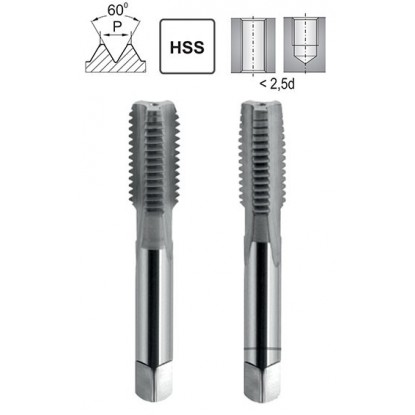
The chamfer on No. 1 is 4 times as long as the chamfer on No. 2 — the difference is immediately visible when you place them side by side. No. 1 has an incomplete thread profile; only No. 2 has the full profile. The number is also indicated on the shank: No. 1 has one ring, No. 2 has none. Keep the set together and always start with the roughing tap.
Hand tapping step by step
Drill bit 11.8 mm
Chamfer 8 threads
Chamfer 2 threads
Tolerance 6H
Turning sequence: half a turn clockwise, a quarter turn counterclockwise | Between taps: remove chips from the hole
Start with the hole. The drill diameter is easy to calculate: thread diameter 13 mm minus pitch 1.25 mm gives 11.75 mm — in practice, use a 11.8 mm drill bit. An undersized hole is a common cause of a tap twisting off in the workpiece.
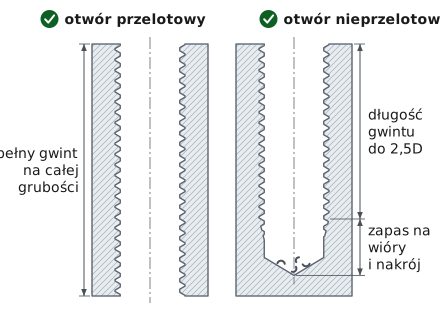
The set taps both types of holes. In a through hole, the thread extends through the full material thickness. In a blind hole, cut the thread to 32.5 mm, or 2.5 times the thread diameter (2.5 x 13 mm, shown as 2.5D in the drawing). Drill the hole deeper than the thread. The finishing tap has a chamfer spanning 2 threads, so approx. 2 incomplete threads remain near the bottom. The extra depth below the thread accommodates them along with the chips.
Fit the roughing tap in the tap wrench and position it perpendicular to the surface. Check the angle from two sides, for example with a square. Turn half a turn clockwise, then a quarter turn counterclockwise. Reversing breaks the chip into short pieces – a slight crunch is normal. The first threads determine whether the thread will be straight.
Back out the roughing tap and remove chips from the hole. Screw the finishing tap into the cut threads by hand – it should engage them on its own. Continue turning at the same rhythm as with the roughing tap. The finishing tap removes the remaining material and cuts the groove to the full profile within tolerance 6H. When it screws in smoothly all the way, the thread is complete – check it with an M13x1.25 screw.
Hand Tap M13x1.25 DIN 2181/2 6H HSS is designed to produce M13 metric fine threads with a pitch of one and a quarter millimeters in structural steels and metal alloys with tensile strengths up to eight hundred megapascals. The two-tap workflow — a first starter tap and a second finishing tap — stabilizes the machining process and enables class six H fit to be maintained.
Technical specifications: nominal diameter thirteen millimeters; pitch one and a quarter millimeters; sixty° profile according to ISO 68-1; internal thread tolerance 6H according to ISO 965; right-hand thread; straight flutes ensure predictable chip evacuation. The ground high-speed steel (HSS) version maintains edge sharpness and reduces the risk of microchipping. In accordance with DIN 2181/2, the process takes place in two stages, while an orderly workflow is supported by M13x1.25 Hand Tap Set. Recommended tap drill: eleven and eight tenths millimeters; using emulsion or active cutting oil improves thread root surface quality and extends edge life.
Reference standards: DIN 2181/2 (design), ISO 68-1 (sixty° profile) and ISO 965 (tolerances, class 6H) guarantee compatibility with inspection equipment and predictable thread geometry in one-off and short-run production.

The set contains two taps – a first roughing tap for initial guidance and a second finishing tap for producing the final thread profile.
Yes, the set can be used for both through holes and blind holes.
M13x1.25 hand taps are designed for machining low-carbon steel, aluminum alloys, brass and other materials with good machinability.
No customer reviews for the moment.
All orders are delivered by courier company GLS. For orders exceeding 369 PLN gross shipping is FREE
| Courier GLS | Przelew24 / Prepayment | 14,76 zł gross | Delivery time 1 working day |
| Courier GLS | Cash on delivery | 17,26 zł gross | Lead time 1 working day |
This website uses its own and third-party cookies to improve our services and show you advertising related to your preferences by analyzing your browsing habits. To give your consent to its use, press the Accept button.


