





- 98% satisfied customers
- 72h delivery
- 30 dni na zwrot
Description
M8 blind hole machine tap – 40° spiral flute
Technical data and dimensions to DIN 376
| Technical data | |
|---|---|
| Thread | M8 x1.25 (metric coarse) |
| Standard | DIN 376, reduced shank |
| Flute | right-hand spiral, 40° |
| Chamfer | form C, 2–3 threads |
| Thread tolerance | 6H |
| Material | HSSE (HSS-Co5) |
| Overall length | 90 mm |
| Threaded section length | 22 mm |
| Shank diameter | 6 mm |
| Square drive | 4.9 mm |
| Tap drill | 6.8 mm |
| Manufacturer | Narex |
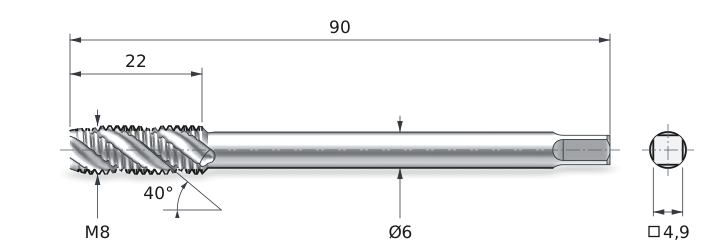
M8 machine tap Narex cuts threads in a blind hole where chips have nowhere to escape. They usually remain at the bottom, jam the tool, and can cause it to twist off. Here, the 40° spiral flute carries chips upward along the helix before the tip reaches the bottom.
Chamfer C starts the thread 2–3 thread pitches from the tip, so the full thread ends close to the bottom. Cobalt-alloyed HSSE steel and the 6H tolerance produce threads for M8 screws in steel, stainless steel, and aluminum.
MaterialHSSE, 5% cobalt
Flute40° spiral flute
ChamferC, 2–3 threads
Tolerance6H
How a spiral flute tap evacuates chips from a blind hole
The 40° flute works like a screw conveyor
The flutes of this tap follow a right-hand helix at an angle of 40° to the axis. The tap rotates clockwise and advances into the hole. Chips cut by the chamfer enter the flute, and the helix carries them upward like the auger in a meat grinder. The bottom of the hole stays clear, and the cutting edges do not encounter packed chips.
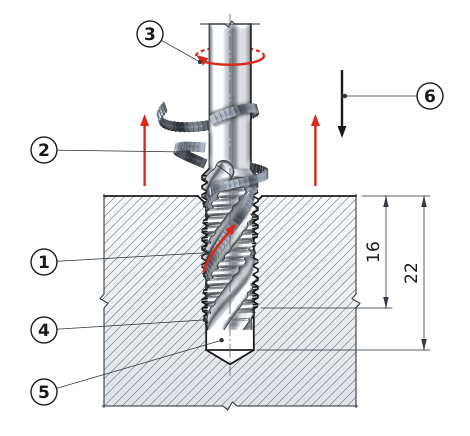
1
The 40° spiral flute carries chips upward from the chamfer.
2
The stepped chip exits the hole and breaks into short pieces.
3
The tap rotates clockwise to cut a right-hand thread.
4
Chamfer C: 2–3 incomplete threads at the end of the thread.
5
Clearance below the tap tip – min. 2 thread pitches above the bottom.
6
Feed 1.25 mm/rev, equal to the pitch of the M8 thread.
40° angle – rapid evacuation of long chips
The greater the helix angle, the faster the flute evacuates chips. A 40° angle works well with long, ductile chips in mild steel, stainless steel, and aluminum. The tradeoff is a slightly thinner core than in a straight flute tap. Therefore, tap precisely along the hole axis without lateral pressure.
Chamfer C – full thread close to the bottom
The chamfer is the tap's tapered lead, which removes material gradually. Form C has 2–3 threads on the taper. The full thread therefore starts 2.5–3.75 mm from the tip, since one thread pitch is 1.25 mm. This is the length of incomplete thread left at the bottom. The longer form B chamfer leaves more incomplete threads, so for a blind hole tap form C is selected.
DIN 376 shank and machine mounting
Reduced shank 6 mm with a 4.9 mm square drive
DIN 376 covers machine taps with a reduced shank, meaning a shank smaller in diameter than the thread. For M8, the shank has a diameter of 6 mm and maintains this diameter from the threaded section to the square drive, with no neck. The minimum bore diameter of an M8 6H thread is 6.647 mm, so the 6 mm shank fits inside the thread. The tap can enter the hole deeper than its 22 mm threaded section. The 4.9 mm square drive at the end of the shank transmits torque from the chuck to the tap.
Mount the tap in a tapping chuck with a 4.9 mm square socket or in a tap collet. On a drill press or machine tool without rigid tapping, use a chuck with axial compensation. It compensates for the difference between the machine feed and the thread pitch, preventing the threads from being stretched or compressed.
▲
The tap tip must not reach the bottom
Set the depth so that the tip stops at least 1–2 threads, or 1.25–2.5 mm, above the bottom of the hole. Hitting the bottom or compacted chips chips the cutting edges and breaks the tap.
Cutting data and tap drill hole for M8
Cutting speed, spindle speed, and feed for HSSE steel
The values apply to an uncoated HSSE tap with ample lubrication. Spindle speed and feed were calculated for a diameter of 8 mm. Feed per revolution always equals the thread pitch, which is 1.25 mm. In a deep blind hole, reduce the speed by 20–30%.
| Workpiece material | Cutting speed [m/min] | Spindle speed [rpm] | Feed [mm/min] |
|---|---|---|---|
| PLow-carbon steel up to 500 MPa | 10–15 | 400–600 | 500–750 |
| PMedium-carbon steel 500–700 MPa, e.g., C45 | 8–12 | 320–480 | 400–600 |
| PAlloy steel 700–1000 MPa | 6–10 | 240–400 | 300–500 |
| MAustenitic stainless steel 304, 316 | 4–8 | 160–320 | 200–400 |
| NWrought aluminum | 20–40 | 800–1590 | 1000–1990 |
Spindle speed = 1000 × 12 m/min ÷ (3.14 × 8 mm) ≈ 477 rpm; feed = 477 rpm × 1.25 mm ≈ 597 mm/min
12 m/min is the cutting speed at the midpoint of the range for C45 steel. 8 mm is the tap diameter, and 1000 converts meters to millimeters. 1.25 mm is the pitch of the M8 thread — the distance the tap advances into the hole per revolution. Set approximately 480 rpm and a feed of approximately 600 mm/min.
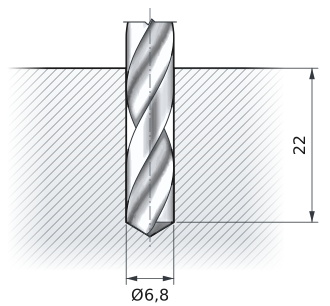
Drill the tap drill hole for M8 with a 6.8 mm drill bit. This is the thread diameter of 8 mm minus the pitch of 1.25 mm. An M8 thread with a 6H tolerance allows a hole diameter from 6.647 to 6.912 mm, so a 6.8 mm drill bit falls in the middle of this range.
The 22 mm dimension in the drawing is the depth of the cylindrical portion of the hole. The 118° cone formed by the drill point lies below it and is not cut by the tap.
M8 thread in a blind hole step by step
1Spot drilling
90° center drill
2Drilling
6.8 mm drill bit to a depth of 22 mm
3Tapping
feed 1.25 mm/rev
✓Inspection
M8 6H gauge
Depth 22 mm = full thread 16 mm + chamfer 3 threads × 1.25 mm + clearance 2 threads × 1.25 mm.
Which materials call for a 40° spiral flute
Steel, stainless steel, and aluminum
HSSE is high-speed steel with approximately 5% cobalt. Cobalt helps the cutting edge retain its hardness at high cutting temperatures. This spiral flute tap is suitable for structural steels and C45 steel, and at lower spindle speeds also for 304 and 316 stainless steels. In wrought aluminum, the 40° spiral flute quickly removes long, sticky chips.
Lubricate generously with an emulsion at a concentration of 5–10% or tapping oil. For stainless steel, use oil or an emulsion at a concentration of 8–12%.
▲
Short chips jam in the 40° spiral flute
Gray cast iron and brass produce small chips that wedge in a steep spiral flute. For these materials, choose a straight flute tap or a tap with a low helix angle.
M8 machine tap The DIN 376/40 C Narex combines three features needed in a blind hole. The 40° spiral flute lifts chips upward, while the C chamfer finishes the full thread 2–3 threads from the bottom. The 6H tolerance produces a thread that fits M8 screws with a 6g tolerance. The 6.8 mm drill bit and 1.25 mm/rev feed remain the same for every material.
Questions about tapping M8 in a blind hole
Drill bit, depth, and hole type
A 6.8 mm drill bit. This is the thread diameter of 8 mm minus the pitch of 1.25 mm. A hole with a 6H tolerance can range from 6.647 to 6.912 mm, so a 6.8 mm drill bit falls in the middle of this tolerance zone.
A spiral flute tap has helical flutes, like a drill bit, and lifts chips upward out of the hole. A straight flute tap retains chips in its flutes, which is why it is used for short-chipping materials such as cast iron.
Add the chamfer length and clearance to the full thread length. For a 16 mm thread: 16 mm + 3 threads × 1.25 mm + 2 threads × 1.25 mm ≈ 22 mm. This clearance accommodates the tap tip and residual chips.
Yes. The tap passes all the way through the hole, and chips exit upward, just as in a blind hole. After tapping, blow out the hole to remove residual chips from the thread.
DIN 376 has a shank smaller than the thread diameter — for M8, the shank is 6 mm with a 4.9 mm square. This shank passes through the tapped hole. DIN 371 has a reinforced shank: for M8, the shank is 8 mm, the same as the thread diameter, with a 6.2 mm square.
Product accessories


Machine Tap M8 DIN 371/40 C HSSE Narex
Reference: 0000012071 In stock > 10 items
€8.16
€10.03 brutto
Reviews
No customer reviews for the moment.
Shipping
All orders are delivered by courier company GLS. For orders exceeding 369 PLN gross shipping is FREE
| Courier GLS | Przelew24 / Prepayment | 14,76 zł gross | Delivery time 1 working day |
| Courier GLS | Cash on delivery | 17,26 zł gross | Lead time 1 working day |
Recommended for you


Viewed products

This website uses its own and third-party cookies to improve our services and show you advertising related to your preferences by analyzing your browsing habits. To give your consent to its use, press the Accept button.
Cookie preferences
Functional cookiesTechnical
Functional cookies are strictly necessary to provide the services of the shop, as well as for its proper functioning, so it is not possible to refuse their use. They allow the user to browse through our website and use the different options or services that exist on it.
Advertising Cookies
These are cookies that collect information about the advertisements shown to users of the website. They can be anonymous, if they only collect information about the advertising spaces shown without identifying the user, or personalised, if they collect personal information about the user of the shop by a third party, for the personalisation of these advertising spaces.
Analytics cookies
Collect information about the user's browsing experience in the shop, usually anonymously, although sometimes they also allow the user to be uniquely and unequivocally identified in order to obtain reports on the user's interests in the products or services offered by the shop.