





- 98% satisfied customers
- 72h delivery
- 30 dni na zwrot
Description
Cutting diameter DØ14 H7hole 14.000–14.018 mm
MaterialHSShigh-speed steel (HSS)
StandardDIN 206hand reamer
Number of cutting edgesZ = 8straight flutes
Technical data for the 14 H7 hand reamer
dimensions, standard, and shank specifications
| Technical data | |
|---|---|
| Cutting diameter D | Ø14 H7 · hole 14.000–14.018 mm |
| Hole tolerance zone | H7 (+0.018 / 0 mm) |
| Type | Fixed-size shank-type hand reamer |
| Dimensional standard | DIN 206 |
| Material | HSS (high-speed steel) |
| Flute length l | 81 mm |
| Shank length l₁ | 58 mm |
| Overall length L | 163 mm |
| Number of cutting edges Z | 8 (helical flutes) |
| Shank / drive | Straight shank with square drive (for a tap wrench) |

Hand reamer 14 H7 NRTh — characteristics
construction, operation, and applications
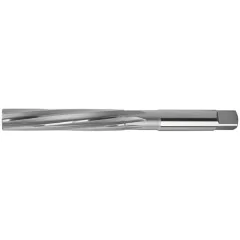
Hand reamer 14 H7 NRTh (DIN 206) is a shank-type finishing reamer designed for cylindrical holes. Its purpose is to bring a drilled Ø14 hole into the tight tolerance zone H7 (14.000–14.018 mm): it removes a minimal stock allowance while improving roundness and smoothing the hole wall.
The reamer is made of high-quality Polish-made high-speed steel (HSS). The cutting section features 8 straight cutting edges — the greater number of edges distributes cutting resistance, resulting in better hole roundness and less vibration than with a two-lip drill. The gently tapered lead provides self-centering, and the square drive on the straight shank allows operation with a tap wrench and a steady feed.
Reaming serves the purpose of finishing, not roughing. A drilled hole has a loose IT10–IT11 tolerance, and the reamer brings it to grade H7, while also reducing surface roughness. Remember that the tool follows the path of the hole and will not correct a crooked hole — the initial hole must be drilled perpendicular to the surface. A hand reamer differs from a machine reamer in having a longer lead taper and more cutting edges, providing more even cutting. It is well suited to finishing holes for pins and shafts, when a running fit or a light interference fit is required.
H7 tolerance and Ø14 hole accuracy
final tolerance zone of the machined hole
Ø14 mm hole size by tolerance grade (ISO 286)
| Designation | Hole Ø range [mm] | Deviations [mm] | IT tolerance grade |
|---|---|---|---|
| 14 H6 | 14.000 – 14.011 | +0.011 / 0 | 11 µm |
| 14 H7 | 14.000 – 14.018 | +0.018 / 0 | 18 µm this product |
| 14 H8 | 14.000 – 14.027 | +0.027 / 0 | 27 µm |
| 14 H9 | 14.000 – 14.043 | +0.043 / 0 | 43 µm |
| 14 H11 | 14.000 – 14.110 | +0.110 / 0 | 110 µm |
Your reamer produces tolerance grade H7 — finished hole Ø14.000–14.018 mm; the value is stated directly, without conversion from tables. A narrower tolerance zone means a more accurate hole. The reamed surface is smooth — typically Ra 0.4–1.6 µm, significantly better than after drilling alone (approx. 1.6–3.2 µm).
Manual machining — how to ream Ø14 H7
tap wrench operation, allowance and predrilled hole
The reamer is fitted to a tap wrench using the square drive of the shank and operated by hand — with smooth, steady rotation in one direction. For reaming to Ø14 H7, leave a 0.2–0.3 mm allowance on diameter, by drilling a pilot hole Ø13.7 mm and finishing it with the reamer. Maintain moderate, even pressure and do not reverse rotation while cutting. Use generous lubrication: cutting oil reduces cutting resistance and improves the hole wall finish to Ra 0.4–1.6 µm (approximately 1.6–3.2 µm after drilling alone).
▲Important: is a tool for manual machining — it is not intended for powered operation at high speeds. High-speed steel loses hardness above approx. 600 °C, so lubricate generously. Do not stop the reamer in the hole or reverse rotation — always withdraw it while continuing to rotate forward; withdrawing without rotation risks chip jamming, chipped cutting edges and a poorer hole finish.
Applications — workpiece materials
groups P1.2–P1.3 according to the material classification
✓Unalloyed and structural steel
✓Free-machining steel
✓Nonferrous metals — brass, bronze, copper
✓Light alloys and soft metals
▲Alloy steel — possible with generous lubrication and low speeds
✗Hardened steel and hardened stainless steel — beyond the capabilities of HSS
Frequently asked questions
It covers unalloyed and free-machining steels, nonferrous metals (brass, bronze, copper), and light alloys — group P1.2–P1.3. Alloy steel can be machined at low rotational speed with lubrication. Hardened steels and hardened stainless steels are excluded.
The hole falls within 14.000–14.018 mm, corresponding to the H7 tolerance zone (+0.018 / 0 mm). The narrower the zone, the more accurate the hole; roughness decreases to Ra 0.4–1.6 µm compared with approximately 1.6–3.2 µm after drilling.
Approximately Ø13.7 mm, corresponding to a stock allowance of 0.2–0.3 mm on the diameter. After drilling, ream the hole by hand — remember to drill perpendicular to the surface, as the reamer cannot correct misalignment.
Product accessories


Reviews
No customer reviews for the moment.
Shipping
All orders are delivered by courier company GLS. For orders exceeding 369 PLN gross shipping is FREE
| Courier GLS | Przelew24 / Prepayment | 14,76 zł gross | Delivery time 1 working day |
| Courier GLS | Cash on delivery | 17,26 zł gross | Lead time 1 working day |
Recommended for you



This website uses its own and third-party cookies to improve our services and show you advertising related to your preferences by analyzing your browsing habits. To give your consent to its use, press the Accept button.
Cookie preferences
Functional cookiesTechnical
Functional cookies are strictly necessary to provide the services of the shop, as well as for its proper functioning, so it is not possible to refuse their use. They allow the user to browse through our website and use the different options or services that exist on it.
Advertising Cookies
These are cookies that collect information about the advertisements shown to users of the website. They can be anonymous, if they only collect information about the advertising spaces shown without identifying the user, or personalised, if they collect personal information about the user of the shop by a third party, for the personalisation of these advertising spaces.
Analytics cookies
Collect information about the user's browsing experience in the shop, usually anonymously, although sometimes they also allow the user to be uniquely and unequivocally identified in order to obtain reports on the user's interests in the products or services offered by the shop.