






Description
dimensions, standard, and shank specifications
| Technical data | |
|---|---|
| Cutting diameter D | Ø5 H7 · hole 5.000–5.012 mm |
| Hole tolerance zone | H7 (+0.012 / 0 mm) |
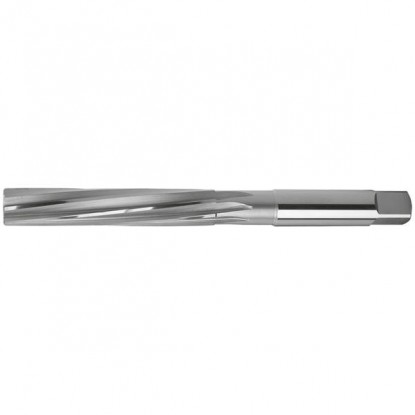
| Type | Fixed-size shank-type hand reamer |
| Dimensional standard | DIN 206 |
| Material | HSS (high-speed steel) |
| Flute length l | 44 mm |
| Shank length l₁ | 32 mm |
| Overall length L | 87 mm |
| Number of cutting edges Z | 6 (straight flutes) |
| Shank / drive | Straight shank with square drive (for a tap wrench) |
construction, operation, and applications
The tool is made of high-quality Polish-made high-speed steel (HSS), giving the cutting edges high hardness and wear resistance — they retain their size for a long time. The cutting section has 6 straight cutting edges that distribute cutting resistance over multiple edges, resulting in a rounder hole and smoother operation than with a drill. The tapered lead centers the reamer, and the straight shank with a square drive connects to a tap wrench.
The operation is intended for finishing operation, not roughing. Drilling leaves a hole of grade IT10–IT11, while the reamer brings it to H7 and improves wall smoothness. Bear in mind that the reamer follows the hole and cannot correct its misalignment, so the pilot hole should be perpendicular and concentric. Unlike a machine reamer, the hand model has a longer tapered lead and more cutting edges — making even cutting easier. It is often used to prepare holes in machine tooling, where locating components require a repeatable fit.
final tolerance zone of the machined hole
| Designation | Hole Ø range [mm] | Deviations [mm] | IT tolerance grade |
|---|---|---|---|
| 5 H6 | 5.000 – 5.008 | +0.008 / 0 | 8 µm |
| 5 H7 | 5.000 – 5.012 | +0.012 / 0 | 12 µm this product |
| 5 H8 | 5.000 – 5.018 | +0.018 / 0 | 18 µm |
| 5 H9 | 5.000 – 5.030 | +0.030 / 0 | 30 µm |
| 5 H11 | 5.000 – 5.075 | +0.075 / 0 | 75 µm |
Your reamer produces tolerance grade H7 — finished hole Ø5.000–5.012 mm; the value is stated directly, without conversion from tables. A narrower tolerance zone means a more accurate hole. The reamed surface is smooth — typically Ra 0.4–1.6 µm, significantly better than after drilling alone (approx. 1.6–3.2 µm).
tap wrench operation, allowance and predrilled hole
The tap wrench fits over the square drive of the straight shank; guide the reamer by hand with a steady motion in one direction, without jerking. Before machining to Ø5 H7, leave a 0.1–0.2 mm allowance on diameter and drill a pilot hole Ø4.8 mm, then finish with the reamer. With small diameters, guide the tool gently without lateral pressure — the slender shank is easily overloaded. Work with generous lubrication — cutting oil reduces cutting resistance and improves the surface finish to Ra 0.4–1.6 µm (drilling produces approximately 1.6–3.2 µm).
groups P1.2–P1.3 according to the material classification
For ordinary unalloyed steels, free-machining steels, nonferrous metals, and light alloys — yes. Avoid hardened steels and hardened stainless steels, as they exceed the capabilities of HSS. The intended materials are in group P1.2–P1.3.
The H7 zone, or +0.012 / 0 mm — the finished hole measures 5.000–5.012 mm. Grade H7 is a typical precision fit; after reaming, roughness is within Ra 0.4–1.6 µm.
Drill it with a Ø4.8 mm drill (stock allowance of 0.1–0.2 mm on the diameter), perpendicular to the surface. Ream slowly in one direction with generous lubrication — this ensures the H7 tolerance zone and low roughness.

Reference: 0000005480 In stock > 10 items
€74.45 brutto
No customer reviews for the moment.
All orders are delivered by courier company GLS. For orders exceeding 369 PLN gross shipping is FREE
| Courier GLS | Przelew24 / Prepayment | 14,76 zł gross | Delivery time 1 working day |
| Courier GLS | Cash on delivery | 17,26 zł gross | Lead time 1 working day |
This website uses its own and third-party cookies to improve our services and show you advertising related to your preferences by analyzing your browsing habits. To give your consent to its use, press the Accept button.


