

This website uses its own and third-party cookies to improve our services and show you advertising related to your preferences by analyzing your browsing habits. To give your consent to its use, press the Accept button.



Description
dimensions, standard, and shank specifications
| Technical data | |
|---|---|
| Cutting diameter D | Ø45 H7 · hole 45.000–45.025 mm |
| Hole tolerance zone | H7 (+0.025 / 0 mm) |
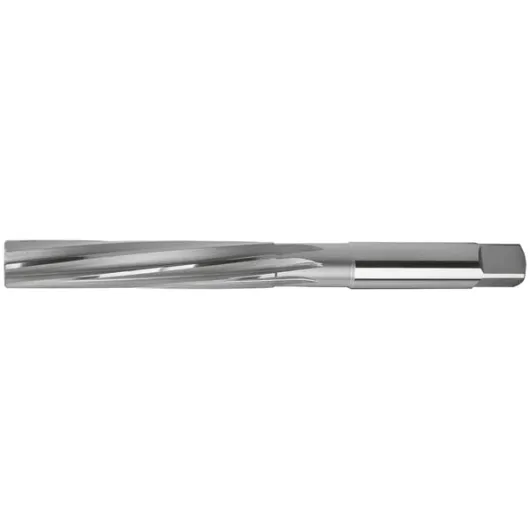
| Type | Fixed-size shank-type hand reamer |
| Dimensional standard | DIN 206 |
| Material | HSS (high-speed steel) |
| Flute length l | 163 mm |
| Shank length l₁ | 120 mm |
| Overall length L | 326 mm |
| Number of cutting edges Z | 12 (straight flutes) |
| Shank / drive | Straight shank with square drive (for a tap wrench) |

construction, operation, and applications
The reamer is made from high-grade Polish HSS high-speed steel. Its 12 straight cutting edges each carry a lower cutting force — resulting in better hole roundness and reduced vibration compared with a drill with two cutting edges. The extended, slightly tapered lead helps align the tool with the axis of the predrilled hole, while the square drive on the shank transfers torque evenly from the tap wrench.
Reaming is a finishing operation, not a roughing operation. After drilling, the hole remains within a loose IT10–IT11 tolerance range, and the reamer improves its accuracy to H7 and smooths the surface. Bear in mind that the tool follows the existing hole and will not straighten a crooked hole — so drill the initial hole perpendicular to the surface. Compared with a machine reamer, a hand reamer has a longer tapered lead and more cutting edges, helping remove the allowance evenly. It is suitable for one-off and repair work — when fitting locating pins, where a repeatable, accurate hole is essential.
final tolerance zone of the machined hole
| Designation | Hole Ø range [mm] | Deviations [mm] | IT tolerance grade |
|---|---|---|---|
| 45 H6 | 45.000 – 45.016 | +0.016 / 0 | 16 µm |
| 45 H7 | 45.000 – 45.025 | +0.025 / 0 | 25 µm this product |
| 45 H8 | 45.000 – 45.039 | +0.039 / 0 | 39 µm |
| 45 H9 | 45.000 – 45.062 | +0.062 / 0 | 62 µm |
| 45 H11 | 45.000 – 45.160 | +0.160 / 0 | 160 µm |
Your reamer produces tolerance grade H7 — finished hole Ø45.000–45.025 mm; the value is stated directly, without conversion from tables. A narrower tolerance zone means a more accurate hole. The reamed surface is smooth — typically Ra 0.4–1.6 µm, significantly better than after drilling alone (approx. 1.6–3.2 µm).
tap wrench operation, allowance and predrilled hole
The tool is driven by a tap wrench fitted over the square drive on the shank, turning it evenly in one direction with light, steady pressure. For a Ø45 H7 hole, allow a 0.4–0.5 mm allowance on diameter — predrill Ø44.5 mm, then ream by hand. The larger diameter requires a sturdy tap wrench and more torque — guide the tool steadily. Lubricate generously with cutting oil: this reduces resistance and allows a surface finish of Ra 0.4–1.6 µm, much smoother than after drilling (approx. 1.6–3.2 µm).
groups P1.2–P1.3 according to the material classification
Primarily unalloyed and free-machining steels, nonferrous metals and light alloys (group P1.2–P1.3). Alloy steel can be machined with generous lubrication and low speeds. Hardened steels and hardened stainless steels are beyond the capabilities of HSS.
You will achieve an H7 hole, i.e. 45.000–45.025 mm (tolerance zone +0.025 / 0 mm). This is much tighter than drilling alone (IT10–IT11). The surface finish also improves to Ra 0.4–1.6 µm.
For this diameter, leave a 0.4–0.5 mm allowance and predrill a Ø44.5 mm hole. This allowance enables the reamer to remove an even layer, producing an accurate size and a smooth hole wall.
All orders are shipped by FedEx. Orders with a value of €369 or more are delivered free of charge.
| Destination country | Shipping cost (incl. 23% VAT) |
|---|---|
| Austria, Belgium, Bulgaria, Croatia, Czechia, Denmark, Estonia, France, Germany, Greece, Hungary, Italy, Latvia, Lithuania, Luxembourg, Netherlands, Romania, Slovakia, Slovenia | €24.60 |
| Ireland, Portugal, Spain | €30.75 |
| Sweden | €49.20 |
| Finland | €73.80 |
| Türkiye (no VAT) | €20.00 |
| United Kingdom (no VAT) | €50.00 |
All prices in the shop and on this page include 23% VAT. No VAT is charged on deliveries to countries outside the EU (United Kingdom, Türkiye). Delivery time: 2–4 working days.