







Net price: €3.95
Description
| Technical data | |
|---|---|
| Shape | Round (R) |
| Insert diameter d | 12.70 mm |
| Insert thickness s | 4.76 mm |
| Clearance angle | 11° (positive) |
| Tolerance class | M |
| Type | hole + chip breaker (T) |
| Brand | Ceratizit |
face milling and copy milling of structural steels — ISO P group
| Material | Vc [m/min] | Feed fz [mm/tooth] | ap [mm] | ae [% D] |
|---|---|---|---|---|
| PSteel | 150-220 | 0.10-0.22 | 0.5-3.0 | 60-80 |
full-radius edge, positive 11° geometry, hole with chip breaker
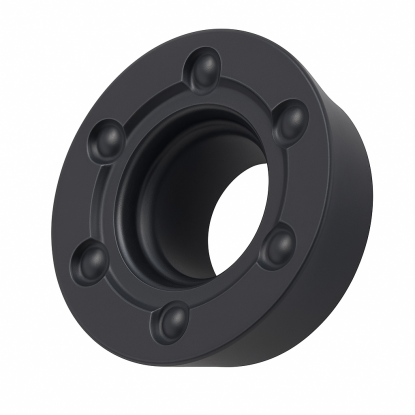
The RPMT 120400 milling insert is a round indexable insert made of cemented carbide by Ceratizit, designed for milling steel. The full-radius edge replaces a conventional corner and gives the insert exceptional mechanical strength. There is no corner that could chip under the impact loads of interrupted cutting. The round profile and positive clearance angle of eleven degrees make this insert suitable for copy milling, profile milling and machining three-dimensional molds. The mounting hole and single-sided chip breaker, designated type T according to ISO 1832, guide the chip when cutting with one side of the insert.
The RPMT 120400 insert performs well in copy milling dies, injection molds and curved surfaces in structural steels. Its behavior is determined by the depth of cut because the round edge changes geometry along its circumference. With a radius R of 6.35 mm and a depth ap of 1.5 mm, calculate the effective entering angle using κ = arccos((R − ap) / R) = arccos((6.35 − 1.5) / 6.35), which gives approximately 40°. Such a small angle produces a thin chip and low cutting forces. This allows the round insert to cut stably even on lighter machines and with longer tool overhangs.
As the depth increases, the entering angle increases and the chip becomes thicker. Therefore, keep the depth within half the radius, or up to approximately 3.2 mm per pass. For structural steel, use a cutting speed from 150 to 220 m/min and a feed per tooth from 0.10 to 0.22 mm. Use climb milling so the cutting edge enters the material at the thicker part of the chip and cuts more smoothly. Index the insert to successive edge positions as soon as the working area begins to wear. Round inserts of this type are supplied by Ceratizit.
A round insert cannot reproduce sharp internal corners — the smallest contour radius equals the insert radius, which is 6.35 mm. Keep the depth of cut within 0.5×R (approximately 3.2 mm), to avoid overloading the edge.
how to read the RPMT 120400 code — positions 1–6 of the designation
Designation RPMT 120400 according to the standard ISO 1832: 4 letters describe geometry and construction, 2 numeric codes describe dimensions. Each field has a number, an icon, and a brief description.
ISO 1832 designation decoder — how to read the code
Positions 1–3 · ISO code
1RShape
Round
peripheral edge without corners
2PClearance angle
α = 11°
positive, single-sided
3MTolerance
Class M (intermediate)
IC ±0.08 · thickness ±0.13 mm
Positions 4–6
4TType
Countersunk hole + chip breaker
countersink 40–60°, single-sided chip breaker
512Diameter
d = 12 mm
round insert — full radius
604Thickness
s = 4.76 mm
between rake faces
✓ Peripheral edge — full circle, no corners
milling operations and material groups confirmed for this insert
Application range
| ✔ | Copy milling and profile milling — dies, injection molds, curved surfaces and 3D molds. |
| ✔ | Plunge milling and rough stock removal thanks to the strong round edge. |
| ✔ | Structural steel in the ISO P group — application confirmed by the existing product description. |
| ✔ | Interrupted cuts and uneven stock allowance — the absence of a corner reduces the risk of edge chipping. |
| ✗ | Sharp internal corners with a radius smaller than 6.35 mm — the round geometry cannot reproduce them. |
| ✗ | Depth of cut ap greater than 0.5×R (approximately 3.2 mm) per pass — places excessive load on the cutting edge. |
operations, depth of cut and milling parameters
For copy milling, profile milling, machining 3D molds and plunge milling. The full-radius edge withstands impacts, so the insert is also suitable for rough stock removal in steel. The insert diameter is 12.70 mm, and the thickness is 4.76 mm.
Keep the depth within half the insert radius. For a radius of R 6.35 mm this gives approximately 3.2 mm per pass. At greater depths, the entering angle and chip thickness increase, placing additional load on the edge.
The round edge has no corner that could chip. At a shallow depth of cut, the effective entering angle is small — for ap 0.5 mm and R of 6.35 mm, it is approximately 23° — so cutting forces increase gradually with depth.
For structural steel, use a cutting speed of 150–220 m/min and a feed per tooth of 0.10–0.22 mm. Use climb milling and keep the depth up to 3.2 mm. The existing description confirms that this insert is suitable for steel.
No customer reviews for the moment.
All orders are delivered by courier company GLS. For orders exceeding 369 PLN gross shipping is FREE
| Courier GLS | Przelew24 / Prepayment | 14,76 zł gross | Delivery time 1 working day |
| Courier GLS | Cash on delivery | 17,26 zł gross | Lead time 1 working day |
This website uses its own and third-party cookies to improve our services and show you advertising related to your preferences by analyzing your browsing habits. To give your consent to its use, press the Accept button.


