 Polski




- 98% satisfied customers
- 72h delivery
- 30 dni na zwrot

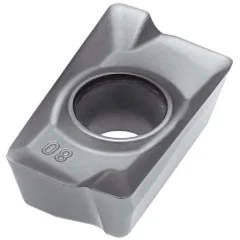
Carbide insert CNMA 120408 UC5115 Mitsubishi
12341
€4.86 tax inc.
Net price: €3.95
Description
CNMA 120408 turning insert – 80° indexable diamond
| Technical data | |
|---|---|
| Inscribed circle IC | 12.7 mm |
| Side length l | 12.9 mm |
| Insert thickness s | 4.76 mm |
| Corner radius rε | 0.8 mm |
| ANSI code | CNMA 432 |
| Carbide grade | UC5115 (Mitsubishi) |
UC5115 carbide diamond insert – applications and design
double-sided 80° diamond with a mounting hole, without a chip breaker
The CNMA 120408 turning insert is a double-sided, diamond-shaped indexable insert made of Mitsubishi UC5115 grade cemented carbide, designed for turning cast iron. The C shape, a diamond with a 80° included angle, combines a rigid, strong corner with good contour access during longitudinal turning and facing. Negative geometry with a 0° clearance angle allows both sides of the insert to be used, providing a total of four cutting edges. Type A denotes a mounting hole and a smooth rake face without a chip breaker, making the insert best suited to materials that break into short chips.
Key features of the UC5115 cemented carbide insert
- Four cutting edges — 2 corners of 80° on each of the two sides reduce the cost per cutting edge compared with single-sided inserts.
- Grade UC5115 for cast iron — cemented carbide designed for high-productivity machining of various cast iron grades (ISO K group).
- Included angle 80° — a rigid, load-resistant cutting edge that withstands interrupted turning and machining with stock allowance.
- Type A without a chip breaker, with a smooth rake face — chip flow is controlled by the workpiece material itself.
- Tolerance class M provides repeatable cutting edge positioning after indexing the insert in the holder pocket.
- Dimensions comply with ISO 1832: IC 12.7 mm (1/2″), thickness 4.76 mm, nose radius 0.8 mm.
Applications and cutting data selection for the diamond-shaped insert
The CNMA 120408 insert (also written without a space as cnma120408) is suitable for turning bodies, discs, pump housings and pulleys made of gray and ductile cast iron. Calculate spindle speed using n = 1000·Vc/(π·D): for example, when turning gray cast iron at Vc = 150 m/min on a shaft with a diameter of 80 mm, the result is approximately 597 rpm. Without a chip breaker, chip flow is controlled by the material itself — cast iron breaks into short fragments, so the insert also runs steadily when turning without coolant. The large 80° included angle provides a cutting edge resistant to loads and vibration on surfaces with uneven stock allowance.
Grade UC5115 is a carbide designed for efficient machining of various cast iron grades, valued for its edge abrasion resistance during extended continuous operation. Indexable inserts in this series are supplied by Japanese manufacturer Mitsubishi. The mounting hole ensures secure, repeatable seating of the insert in the holder pocket. When selecting an insert from the CNMA 1204 family, use the nose radius as a guide: 0.4 mm is a finishing option for low feed rates, 0.8 mm combines surface finish with edge strength, and 1.2 mm is selected for roughing at higher feed rates.
▲
Application limitation
The CNMA 120408 insert in grade UC5115 is conventional cemented carbide, not CBN. For turning hardened cast iron or hard machining, select an insert with a cutting edge made of cubic boron nitride (CBN).
Rhombic insert designation decoder according to ISO 1832
how to read the CNMA 120408 code — designation positions 1–7
Designation CNMA 120408 according to the standard ISO 1832: 4 letters describe geometry and construction, 3 numeric codes describe dimensions. Each field has a number, an icon, and a brief description.
Frequently asked questions about the CNMA 120408 insert
edges, geometry and cutting data for cast iron turning
Four — the 80° diamond has 2 corners usable per side, and the negative geometry (0° clearance angle) allows both sides of the insert to be used. When an edge becomes dull, simply index the insert in its pocket without changing the holder.
The fourth letter of the designation is A — a mounting hole and a smooth rake face without a chip breaker. This geometry is designed for cast iron, which naturally breaks into short chips, so active chip breaking is not needed.
Only in corner radius: 0.4 mm is used for finishing at low feed rates, 0.8 mm is the general-purpose version, and 1.2 mm is selected for roughing. The other dimensions (IC 12.7 mm, thickness 4.76 mm) are identical across the family.
Grade UC5115 is designed for cast iron (ISO K group) and performs best in this material. For turning steel, select an insert in a grade from group ISO P, suited to longer, ductile chips.
Product accessories


Reviews
No customer reviews for the moment.
Shipping
All orders are delivered by courier company GLS. For orders exceeding 369 PLN gross shipping is FREE
| Courier GLS | Przelew24 / Prepayment | 14,76 zł gross | Delivery time 1 working day |
| Courier GLS | Cash on delivery | 17,26 zł gross | Lead time 1 working day |
Recommended for you


Viewed products
This website uses its own and third-party cookies to improve our services and show you advertising related to your preferences by analyzing your browsing habits. To give your consent to its use, press the Accept button.
Cookie preferences
Functional cookiesTechnical
Functional cookies are strictly necessary to provide the services of the shop, as well as for its proper functioning, so it is not possible to refuse their use. They allow the user to browse through our website and use the different options or services that exist on it.
Advertising Cookies
These are cookies that collect information about the advertisements shown to users of the website. They can be anonymous, if they only collect information about the advertising spaces shown without identifying the user, or personalised, if they collect personal information about the user of the shop by a third party, for the personalisation of these advertising spaces.
Analytics cookies
Collect information about the user's browsing experience in the shop, usually anonymously, although sometimes they also allow the user to be uniquely and unequivocally identified in order to obtain reports on the user's interests in the products or services offered by the shop.