






Description
| Technical data | |
|---|---|
| Edge length l | 16 mm |
| Insert thickness s | 4.76 mm |
| Corner radius rε | per the product data sheet |
| Clearance angle | 11° (positive) |
| PDER code | manufacturer's suffix; meaning per the product data sheet |
| Number of edges | 2 |
| Grade | K10 (uncoated carbide) |
values for aluminum and nonferrous metals from the product data
| Machining operation | Material | Vc [m/min] | Feed fz [mm/tooth] | ap [mm] |
|---|---|---|---|---|
| Finishing | NAluminum and nonferrous metals | 400-600 | 0.10-0.15 | 1-2 |
| Semi-finishing | NAluminum and nonferrous metals | 350-500 | 0.10-0.20 | 2-4 |
| Roughing | NAluminum and nonferrous metals | 300-450 | 0.15-0.25 | 4-6 |
rectangular 85°; PDER is a manufacturer's code requiring the product data sheet
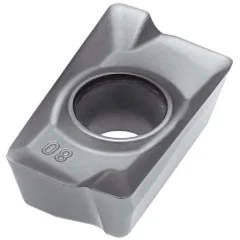
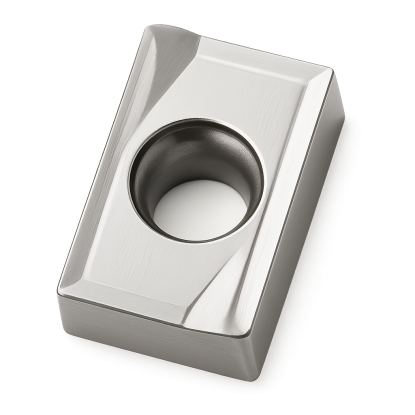
The APKT 1604 milling insert is a positive indexable insert made of cemented carbide in grade K10, designed for milling heads with an entering angle of 90°. Shape A, a rectangle with a corner angle of 85°, provides two cutting edges and a vertical wall when milling shoulders and pockets. The positive clearance angle of 11° reduces cutting forces and power consumption, making the insert well suited to aluminum and nonferrous metals. Grade K10 is precision-ground, uncoated carbide with tolerance class K and a thickness accuracy of ±0.025 mm. PDER is the manufacturer's geometry suffix, and its letters should not be decoded without the APKT product data sheet. The corner radius must be confirmed in the product data sheet because the supplied code does not include a radius component.
For ISO N with a 90° milling head, use the table ranges conservatively: Vc 300-600 m/min, fz 0.10-0.25 mm/tooth and ap 1-6 mm. Select the exact parameters from the insert and milling head data sheets. For example, for a milling head with D = 50 mm and Vc = 400 m/min: n = 1000·400/(π·50) ≈ 2546 rpm.
Uncoated, sharp carbide K10 reduces built-up edge when machining nonferrous metals, producing a smooth, burr-free surface. Tolerance class K ensures uniform height of all inserts seated in the milling head, so the face remains even after face milling. Select the depth of cut ap according to workholding rigidity: at an angle of 90°, forces are mainly radial, so a poorly supported workpiece is prone to vibration. Use a generous flow of emulsion or compressed air for cooling to remove chips efficiently from the cutting zone.
Grade K10 is uncoated carbide — it is not intended for hardened steels or heat-resistant superalloys (ISO S group). For structural and stainless steels, select a PVD (physical vapor deposition) coated version, for example in grade H6310.
how to read the APKT 1604 PDER code — positions 1–10 of the designation
Designation APKT 1604 PDER according to the standard ISO 1832: 4 letters describe the geometry and construction, 2 numeric codes describe the dimensions, and the suffix PDER — the wiper edge geometry. Each field has a number, an icon and a brief description.
ISO 1832 designation decoder — how to read the code
Positions 1–3 · ISO code
1AShape
Parallelogram 85°
2 corners of 85° per side
2PClearance angle
α = 11°
positive, single-sided
3KTolerance
Class K (precision)
ground thickness ±0.025 mm
Positions 4–6
4TType
Countersunk hole + chip breaker
countersink 40–60°, single-sided chip breaker
516Edge length
code 16
dimension according to the manufacturer's catalog data sheet
604Thickness
s = 4.76 mm
between rake faces
PDER suffix · wiper edge
7PEntering angle
κ = 90°
90° angle milling cutters and milling heads
8DWiper land
α′ = 15°
wiper land clearance angle
9EEdge condition
Rounded (honed)
greater resistance to chipping
10RHand
Right-hand
standard clockwise spindle rotation
✓ 2 corners × 1 side = 2 cutting edges
90° shoulder milling heads with APKT pockets — materials and operations
| Rating | Application |
|---|---|
| ✔ | Aluminum and aluminum alloys (ISO N group) |
| ✔ | Nonferrous metals — brass, bronze, copper |
| ✔ | Gray and ductile cast iron (ISO K group) |
| ✔ | Milling 90° shoulders, pockets, slots and notches |
| ✔ | Arbor-mounted and shank-type 90° shoulder milling heads with APKT 1604 pockets |
| ✗ | Hardened steels |
| ✗ | Heat-resistant superalloys and titanium (ISO S group) — for uncoated carbide |
materials, number of edges, tolerance and dimensions
For aluminum and nonferrous metals (group ISO N) and gray and ductile cast iron (group ISO K). The carbide K10 is uncoated and ground, providing a sharp edge without built-up edge. Do not use it for hardened steels or heat-resistant superalloys.
Two — shape A is a rectangle with a corner angle of 85° with two sharp corners. The positive geometry with a clearance angle of 11° makes the insert single-sided, cutting with its top face. When a corner becomes dull, rotate the insert in its pocket to the second edge.
Only in tolerance class. APKT has class K with a thickness accuracy of ±0.025 mm, so all inserts in the milling head sit at the same height and produce a smoother face. APMT has class M (±0.05–0.13 mm) — it is less expensive and sufficient for rough milling.
PDER is a manufacturer's suffix and requires the product data sheet. The supplied code APKT 1604 PDER does not include a radius component, so rε = 0.8 mm must not be added. The confirmed basic dimensions are length l 16 mm and thickness s 4.76 mm.

Reference: 10897 In stock < 10 items
€74.45 brutto
No customer reviews for the moment.
All orders are delivered by courier company GLS. For orders exceeding 369 PLN gross shipping is FREE
| Courier GLS | Przelew24 / Prepayment | 14,76 zł gross | Delivery time 1 working day |
| Courier GLS | Cash on delivery | 17,26 zł gross | Lead time 1 working day |
This website uses its own and third-party cookies to improve our services and show you advertising related to your preferences by analyzing your browsing habits. To give your consent to its use, press the Accept button.


