 Polski




- 98% satisfied customers
- 72h delivery
- 30 dni na zwrot

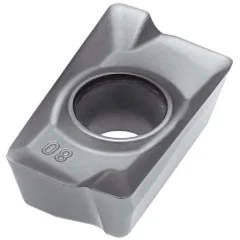
Carbide insert ODMW 060508 SN LC 615E Boehlerit
0000003720
€5.50 tax inc.
Net price: €4.47
Description
ODMW 060508 milling insert – octagonal insert for face milling cast iron
| Technical data | |
|---|---|
| Shape | Octagon 135° |
| Side length l | 6.58 mm |
| Insert thickness s | 5.56 mm |
| Hole diameter d1 | 5.5 mm |
| Corner radius rε | 0.8 mm |
| Clearance angle | 15° (D) |
| Grade | LC 615E (carbide) |
| ISO group | K (cast iron) |
ODMW indexable insert for face milling cast iron
medium roughing with 45° milling heads — ISO group K
| Material | Vc [m/min] | Feed fz [mm/tooth] | ap [mm] | ae [% D] |
|---|---|---|---|---|
| KCast iron | 180-260 | 0.10-0.25 | 1.0-3.0 | 60-80 |
LC 615E carbide insert – design and applications
135° octagon, eight edges, type W without a chip breaker
The ODMW 060508 milling insert is an octagonal indexable insert made of grade LC 615E cemented carbide, designed for medium rough face milling of cast iron. The O shape, an octagon with a corner angle of 135°, provides eight cutting edges on one side of the insert. Type W indicates a countersunk hole without a grooved chip breaker — the rake face is smooth, and chip shape is controlled by the milling head pocket geometry. The 15° clearance angle (letter D) and as-pressed tolerance class M make this insert an economical solution for productive milling of large surfaces. The large number of edges reduces the cost per corner in production milling of cast iron housings and plates.
Key benefits of the ODMW 060508 indexable insert
- Eight edges per insert — the octagon provides 8 usable corners on one side and allows each edge to be indexed in sequence.
- Grade LC 615E for cast iron — carbide selected for ISO group K, medium roughing of cast iron.
- Type W without a chip breaker — smooth rake face; chip shape is controlled by the face mill pocket geometry.
- The 135° corner angle strengthens the cutting edge and withstands interrupted cutting as it enters the material.
- The 0.8 mm corner radius rε combines edge durability with an acceptable finish on the face-milled surface.
- The Ø5.5 mm countersunk mounting hole ensures stable, repeatable seating in the cutter body pocket.
Selecting cutting parameters and operating a face mill
The ODMW 060508 milling insert is used in face mills, where its eight corners fit into the cutter body pockets. Calculate spindle speed using n = 1000·Vc/(π·D): for a milling head with a diameter of 100 mm and a cutting speed of 220 m/min, the result is approximately 700 rpm. With six inserts and a feed per tooth (fz) of 0.20 mm, this gives a feed rate of approximately 840 mm/min. The 45° entering angle in a typical face mill produces chip thinning — chip thickness decreases to approximately 0.14 mm, maintaining high productivity without overloading the edge.
Grade LC 615E is selected for cast iron, where short, brittle chips do not require an aggressive chip breaker. The obtuse corner angle of 135° strengthens the edge in interrupted cutting but generates higher cutting forces than sharper shapes, so both the workpiece and milling head must be held rigidly. Keep the depth of cut within the medium roughing range and rotate the insert to the next corner whenever an edge becomes dull to make full use of all eight edges. For finishing to a low surface roughness, choose an insert with a ground tolerance class and a smaller corner radius.
▲
Application limitation
Grade LC 615E is selected for cast iron (group ISO K) and medium roughing. It is not intended for hardened steels or precision finishing to a low surface roughness — the as-pressed tolerance M and obtuse corner angle 135° limit accuracy.
Octagonal insert designation decoder according to ISO 1832
how to read the ODMW 060508 code — positions 1–7 of the designation
Designation ODMW 060508 according to the standard ISO 1832: 4 letters describe geometry and construction, 3 numeric codes describe dimensions. Each field has a number, an icon, and a brief description.
ISO 1832 designation decoder — how to read the code
1Oshape 2Dangle α 3Mtolerance 4Wtype – 506edge length 605thickness 708radius rε
Positions 1–4 · ISO code
1OShape
Octagon 135°
8 corners of 135° per side
2DClearance angle
α = 15°
positive, single-sided
3MTolerance
Class M (intermediate)
IC ±0.05–0.15 · thickness ±0.13 mm
4WType
Countersunk hole, no chip breaker
40–60° countersink, smooth rake face
Positions 5–7 · dimensions [mm]
506Edge length
l = 6.58 mm
code 06 → edge length
605Thickness
s = 5.56 mm
between rake faces
708Corner radius
rε = 0.8 mm
code ÷ 10 → radius in mm
✓ 8 corners × 1 side = 8 cutting edges
Full designation: ODMW 060508 = octagon 135° · positive 15° · class M · countersunk hole without a chip breaker · l 6.58 mm · s 5.56 mm · rε 0.8 mm
Compatibility and application range
face mills with octagonal insert pockets — ISO group K
| Compatibility | Application |
|---|---|
| ✔ | Face milling large flat surfaces in cast iron (ISO K) |
| ✔ | Face mills with pockets for the ODMW 060508 octagonal insert |
| ✔ | Medium roughing using 8 cutting edges per insert |
| ✔ | Clamping through the Ø5.5 mm hole in a compatible milling head pocket |
| ✗ | Precision finishing to a low surface roughness — tolerance class M and 135° corner angle |
| ✗ | Materials outside ISO group K — require selection of an appropriate grade |
| ✗ | Deep pockets and narrow grooves — the shape is intended for face milling |
Frequently asked questions about the ODMW 060508 insert
edges, materials, and milling parameters
Eight — an octagon has 8 corners at 135° each, and the insert is single-sided and cuts with its top face. When one corner becomes dull, rotate the insert in the pocket to the next edge without replacing the cutter body. The eight corners allow each edge to be indexed in sequence before the insert is replaced.
Grade LC 615E Boehlerit is selected for cast iron (group ISO K) machined by medium roughing — cast iron. It is not intended for hardened steels or precision finishing to a low surface roughness.
The letter W in the designation indicates a type with a countersunk hole, but without a grooved chip breaker — the rake face is smooth. When milling cast iron, chips are short and brittle, so an aggressive chip breaker is unnecessary; chip shape is controlled by the milling head pocket geometry.
For cast iron, use a cutting speed of Vc = 180–260 m/min and a feed per tooth of 0.10–0.25 mm. For a Ø100 mm milling head at Vc = 220 m/min, the speed is n = 1000·Vc/(π·D) ≈ 700 rpm. Keep the values conservative and verify them against the milling head data sheet.
Reviews
No customer reviews for the moment.
Shipping
All orders are delivered by courier company GLS. For orders exceeding 369 PLN gross shipping is FREE
| Courier GLS | Przelew24 / Prepayment | 14,76 zł gross | Delivery time 1 working day |
| Courier GLS | Cash on delivery | 17,26 zł gross | Lead time 1 working day |
Recommended for you


This website uses its own and third-party cookies to improve our services and show you advertising related to your preferences by analyzing your browsing habits. To give your consent to its use, press the Accept button.
Cookie preferences
Functional cookiesTechnical
Functional cookies are strictly necessary to provide the services of the shop, as well as for its proper functioning, so it is not possible to refuse their use. They allow the user to browse through our website and use the different options or services that exist on it.
Advertising Cookies
These are cookies that collect information about the advertisements shown to users of the website. They can be anonymous, if they only collect information about the advertising spaces shown without identifying the user, or personalised, if they collect personal information about the user of the shop by a third party, for the personalisation of these advertising spaces.
Analytics cookies
Collect information about the user's browsing experience in the shop, usually anonymously, although sometimes they also allow the user to be uniquely and unequivocally identified in order to obtain reports on the user's interests in the products or services offered by the shop.