




- 98% satisfied customers
- 72h delivery
- 30 dni na zwrot
Description
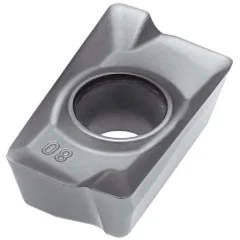
APKT 160408 CBN milling insert – milling hardened steels
| Technical data | |
|---|---|
| Side length l | 16.00 mm |
| Insert thickness s | 4.76 mm |
| Corner radius rε | 0.8 mm |
| Shape | Rectangular 85° |
| Clearance angle | 11° (positive) |
| Number of active CBN cutting edges | 1 |
| Cutting edge material | CBN (borazon) |
| Milling heads | 90° shoulder |

Cutting data for the APKT 160408 CBN insert
vc, fz, and ap ranges for hardened steel and gray cast iron — starting values
| Material | Hardness | vc [m/min] | fz [mm/tooth] | ap [mm] |
|---|---|---|---|---|
| HHardened steel | 50-57 HRC | 100-170 | 0.04-0.08 | up to 0.5 |
| HHardened steel | 58-62 HRC | 80-150 | 0.03-0.06 | up to 0.3 |
| KGray cast iron GG25-GG30 | HB 200-250 | 800-2000 | 0.10-0.30 | up to 0.5 |
The specified ranges correspond to CBN tool manufacturers' data for hard milling and gray cast iron milling. Treat them as starting values for a rigid setup and adjust them according to the data sheet for the specific milling head. For ductile cast iron and wear-resistant and heat-resistant alloys, start at the lower speed limit and increase it after assessing cutting edge wear.
Calculate spindle speed and feed rate using n = 1000·vc/(π·D) and vf = fz · z · n, substituting the milling head diameter D rather than the insert size. For hardened steel at 55 HRC, vc = 120 m/min, and a milling head with D = 50 mm, the result is n = 1000·120/(π·50) ≈ 764 rpm, and with fz = 0.06 mm/tooth and four inserts, vf = 0.06·4·764 ≈ 183 mm/min. The same milling head in gray cast iron at vc = 1000 m/min requires approximately 6370 rpm, so in practice the spindle limits the CBN cutting speed, rather than the insert itself.
APKT 1604 single-edge borazon insert – design and applications
one active CBN cutting edge on a rectangular 85° body for 90° shoulder milling heads
This CBN milling insert is a single-edge insert with an active cutting edge made of cubic boron nitride (CBN, borazon), designed for milling high-hardness materials. Borazon is one of the hardest engineering materials after diamond, giving the insert exceptional wear resistance and dimensional stability. Shape A, a rectangle with a corner angle of 85°, and a positive clearance angle of 11° make the insert suitable for 90° shoulder milling heads for milling shoulders and straight vertical walls. An insert thickness of 4.76 mm and a corner radius of 0.8 mm provide a rigid edge for hard milling. Unlike diamond, borazon does not react chemically with steel, making it suitable for machining ferrous alloys.
Key benefits of the borazon milling insert
- Cubic boron nitride cutting edge — one of the hardest engineering materials after diamond, providing long cutting edge life in hard materials.
- Machining steels up to 60 HRC — milling hardened steels, cast iron, and wear-resistant and heat-resistant alloys.
- Thermal resistance above 1000°C — borazon retains its hardness at high temperatures and does not react chemically with steel.
- Good thermal conductivity removes heat from the cutting zone, reducing the risk of microcracks in the cutting edge.
- Positive 11° geometry with a 85° rectangular shape reduces cutting forces in 90° shoulder milling heads.
- Tolerance class K with ground thickness provides uniform insert height in the milling head during finishing.
Applications and cutting data selection for the CBN insert
The single-edge CBN insert is used for milling hardened steels up to 60 HRC, gray and ductile cast iron, and wear-resistant and heat-resistant alloys. Borazon's high thermal resistance, maintained above 1000°C, allows machining at high cutting speeds and reduces cycle time. The vc, fz, and ap ranges for hardened steel and gray cast iron are listed in the cutting data table in the second section of the description.
Select cutting data for the specific milling head and the stability of the machine tool and workholding. The borazon cutting edge maintains high precision and consistent surface quality at high cutting speeds, allowing hard milling to replace some finish grinding operations. Borazon's good thermal conductivity removes heat from the cutting zone, reduces the risk of microcracks, and stabilizes the process in series production.
▲
CBN insert operating limitations
The CBN cutting edge operates only at a shallow depth of cut — finishing milling heads with CBN inserts have ap limited to 0.5 mm. Mill dry, as coolant causes thermal shock and edge chipping. The setup must be rigid: CBN does not tolerate vibration or impact entry into the material.
Parallelogram insert designation decoder according to ISO 1832
how to read the APKT 160408 code — designation positions 1–7
Designation APKT 160408 according to the standard ISO 1832: 4 letters describe geometry and construction, 3 numeric codes describe dimensions. Each field has a number, an icon, and a brief description.
ISO 1832 designation decoder — how to read the code
1Ashape 2Pangle α 3Ktolerance 4Ttype – 516edge length 604thickness 708radius rε
Positions 1–4 · ISO code
1AShape
Parallelogram 85°
2 corners of 85° per side
2PClearance angle
α = 11°
positive, single-sided
3KTolerance
Class K (precision)
ground thickness ±0.025 mm
4TType
Countersunk hole + chip breaker
countersink 40–60°, single-sided chip breaker
Positions 5–7 · dimensions [mm]
516Edge length
l = 16 mm
code 16 → edge length
604Thickness
s = 4.76 mm
between rake faces
708Corner radius
rε = 0.8 mm
code ÷ 10 → radius in mm
✓ 2 corners × 1 side = 2 cutting edges
Full designation: APKT 160408 = parallelogram 85° · positive 11° · class K · countersunk hole and chip breaker · l 16 mm · s 4.76 mm · rε 0.8 mm
Applications and compatibility of the APKT 160408 CBN insert
90° shoulder milling heads for APKT 1604 inserts — compatible applications and what to avoid
Recommended applications and what to avoid
| Status | Application |
|---|---|
| ✔ | 90° shoulder milling heads for inserts APKT 1604 with a rectangular 85° pocket |
| ✔ | Milling hardened steels up to 60 HRC — shoulders, pockets, straight vertical walls |
| ✔ | Gray and ductile cast iron, and wear-resistant and heat-resistant alloys at high cutting speeds |
| ✔ | Precision machining requiring high surface quality and dimensional repeatability |
Frequently asked questions about the APKT 160408 insert
CBN, workpiece materials, and hard milling principles
CBN is cubic boron nitride (borazon), one of the hardest engineering materials after diamond. It retains its hardness above 1000°C and does not react chemically with steel, making the insert suitable for milling hardened steels up to 60 HRC and cast iron.
Hardened steels up to 60 HRC, gray and ductile cast iron, and wear-resistant and heat-resistant alloys. The material must be hard and homogeneous — this insert is not suitable for soft steels, aluminum, or plastics.
The side length l is 16.00 mm, the insert thickness s is 4.76 mm, and the corner radius rε is 0.8 mm. The shape is a rectangle with a corner angle of 85°.
Use the formula n = 1000·vc/(π·D), substituting the milling head diameter D rather than the insert size. For hardened steel at 55 HRC and vc = 120 m/min with a milling head D = 50 mm: n = 1000·120/(π·50) ≈ 764 rpm, and the feed rate with fz = 0.06 mm/tooth and four inserts is vf = 0.06·4·764 ≈ 183 mm/min. The same milling head in gray cast iron at vc = 1000 m/min requires approximately 6370 rpm.
Product accessories

End mill ST90-AP16-D25-W25-L150-Z02 Smoxh
Reference: 10897 In stock < 10 items
€60.53
€74.45 brutto

Reviews
No customer reviews for the moment.
Shipping
All orders are delivered by courier company GLS. For orders exceeding 369 PLN gross shipping is FREE
| Courier GLS | Przelew24 / Prepayment | 14,76 zł gross | Delivery time 1 working day |
| Courier GLS | Cash on delivery | 17,26 zł gross | Lead time 1 working day |
Recommended for you


This website uses its own and third-party cookies to improve our services and show you advertising related to your preferences by analyzing your browsing habits. To give your consent to its use, press the Accept button.
Cookie preferences
Functional cookiesTechnical
Functional cookies are strictly necessary to provide the services of the shop, as well as for its proper functioning, so it is not possible to refuse their use. They allow the user to browse through our website and use the different options or services that exist on it.
Advertising Cookies
These are cookies that collect information about the advertisements shown to users of the website. They can be anonymous, if they only collect information about the advertising spaces shown without identifying the user, or personalised, if they collect personal information about the user of the shop by a third party, for the personalisation of these advertising spaces.
Analytics cookies
Collect information about the user's browsing experience in the shop, usually anonymously, although sometimes they also allow the user to be uniquely and unequivocally identified in order to obtain reports on the user's interests in the products or services offered by the shop.