





- 98% satisfied customers
- 72h delivery
- 30 dni na zwrot

Description
External threading turning tool SEL 32X32 22 Varel
Left-hand holder SEL-3232P22 for 22 EL indexable inserts
| Technical data | |
|---|---|
| Manufacturer designation | SEL-3232P22 |
| Machining operation | External threading |
| Design | Left-hand (L) |
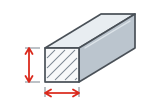
| Shank cross section | 32x32 mm |
| Overall length | 170 mm |
| Distance from cutting edge to back of shank | 40 mm |
| Insert family | 22 EL (also 22 IR) |
| Thread types with the appropriate insert | Metric M – 60° Whitworth BSW – 55° Unified UN – 60° Trapezoidal Tr – 30° |
| Metric pitch range | 3.5–5.5 mm Depending on the selected 22 EL insert |
| Trapezoidal thread pitch range | 4–5 mm |

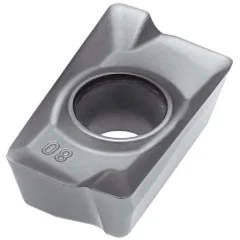
The photo shows a mirror image of the SER-2020K16 holder.
The data in the table applies to the left-hand SEL-3232P22 holder.
The insert shown in the photo is not included with the turning tool.
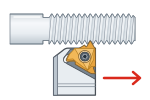
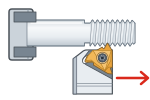

SEL-3232P22 – external thread turning in practice
The workpiece rotates while the cutting edge moves along its axis
External threading turning tool SEL 32X32 22 Varel is a left-hand holder for turning threads on shafts, journals, and sleeves. The 32x32 mm shank is clamped in a suitable lathe tool post. By selecting the appropriate 22 EL insert, you can cut M metric threads and UN inch threads with a 60° profile, as well as Whitworth BSW inch threads with a 55° profile.
The metric pitch range is 3.5–5.5 mm, depending on the selected insert. For BSW and UN inch threads, select an insert to match the thread profile and threads per inch (TPI). Example: a UNC 1 1/2 thread has 6 threads per inch and falls within the range of the 22 EL N60 insert (7–5 threads per inch). This is an indexable tool: when the cutting edge wears out, only the insert is replaced, while the body is retained.
The thread diameter is determined by the shaft being machined, not the holder. The same 22 EL 4 ISO insert can therefore cut, for example, M36 x4 and M64x4. This is why a threading tool replaces a set of dies for fine threads and large diameters.
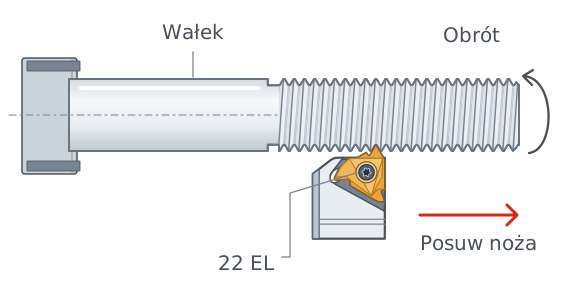
Illustrative diagram. Left-hand turning tool, left-hand thread, feed toward the tailstock.
How does an external threading tool work?
The insert deepens the same profile with each successive pass. The feed remains synchronized with spindle rotation. For a single-start thread, tool travel per revolution equals the thread pitch.
The left-hand turning tool has a mirror-image design and uses 22 EL inserts. It is primarily intended for left-hand threads. The hand of the resulting thread also depends on the tool setup, spindle rotation and feed direction.
22 EL inserts – selecting the thread profile and pitch
One holder, different tasks with the appropriate insert
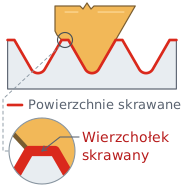
Full profile 22 EL ISO
A full-profile insert, such as 22 EL 4 ISO, is designed for a specific pitch. It machines the thread flanks, root and crest. A different pitch requires the appropriate insert version.
Example: metric profile, 4 mm pitch.
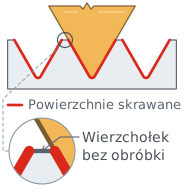
Partial profile 22 EL N60
A partial-profile insert, such as 22 EL N60, covers pitches of 3.5–5 mm (7–5 threads per inch). It does not finish the thread crests. The outside diameter of the workpiece must be prepared beforehand with a suitable tool.
Selection: profile, pitch range and insert grade.
Choose a full-profile insert for production runs of a single thread. The crest is formed together with the flanks, without a separate operation, and the profile is repeatable. An N60 insert with a 60° profile or an N55 insert with a 55° profile covers several pitches, making it useful for short runs and one-off parts. The crest then depends on the previously turned diameter, so profile control is less precise. The left-hand holder also accepts 22 IR inserts, which have the same shape as 22 EL inserts. With a 22 EL TR insert, you can cut Tr trapezoidal threads with pitches of 4–5 mm.

The final “22” indicates the insert size, not the diameter of the thread being cut. The thread profile and pitch depend on the selected 22 EL insert. The 16 EL and 22 IL inserts are not direct substitutes for each other. The full profile of a 22 IR insert corresponds to an internal thread, so choose 22 EL inserts for external threads.
Threading with a turning tool on a lathe – setup and feed
Short overhang, correct cutting edge height and synchronized motion
Set the cutting tip at spindle center height. Check the alignment of the insert profile relative to the workpiece axis. Minimize shank overhang to reduce susceptibility to vibration. Remove chips from the pocket and support surfaces before mounting.
Select the cutting speed and number of passes to suit the insert, material and clamping rigidity. The SEL body alone does not determine cutting data for steel, stainless steel or aluminum.
The SEL 32X32 22 Varel external threading turning tool requires a tool post for a 32x32 mm shank that allows the cutting edge height to be set correctly. When selecting the tool, also check the clearance around the workpiece. The overall length of 170 mm describes the body, not the permissible working overhang. Check the final thread dimensions against the requirements of the part drawing.
Feed for a 4 mm pitch
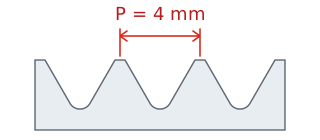
Pitch P is measured along the axis between corresponding points on adjacent thread turns.
For a single-start thread, the tool moves axially by 4 mm for each spindle revolution.
Feed per revolution:
fn = P = 4 mm/rev.
Example: spindle speed n = 150 rpm
vf = n × P = 150 × 4
600 mm/min
Feed rate
150 rpm is a calculation example, not recommended cutting data. The threading cycle requires the feed to be synchronized with the spindle.
Thread turning with a turning tool – approach, cutting pass and retraction
Each pass uses the same four movements, going slightly deeper each time
The thread is formed in several passes. During each pass, the tool repeats the same cycle of four movements, and the 22 EL insert cuts slightly deeper each time until the profile reaches its full depth. The diagram shows one pass of a left-hand SEL turning tool cutting a left-hand thread, with feed toward the tailstock.
Single-pass cycle
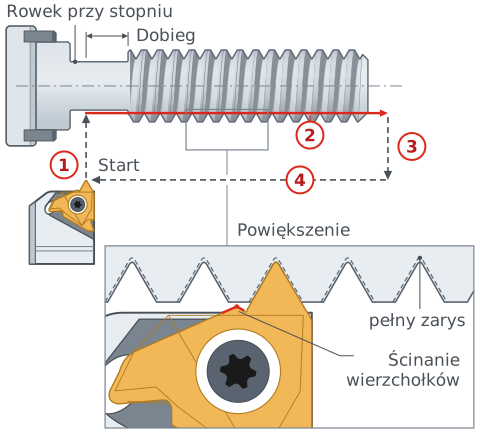
Schematic diagram, top view. Red line – cutting movement, the insert is cutting. Dashed lines – rapid movements without cutting.
1
Approach
The tool moves from the starting point in the groove at the shoulder and feeds in perpendicular to the axis to the depth for this pass. This is a rapid move without cutting.
2
Cutting pass
The insert cuts as it moves along the axis toward the tailstock. For each spindle revolution, the tool advances by the thread pitch P, for example 4 mm.
3
Retraction
Beyond the end face of the shaft, the insert exits the material and the tool rapidly retracts away from the axis.
4
Return
The retracted tool rapidly returns to the starting point in the groove. It begins the next pass with a slightly deeper infeed.
The left-hand turning tool starts the thread from the shoulder side, so the groove at the shoulder is the starting location. It accommodates the insert tip and a short lead-in where the feed synchronizes with the pitch before the insert enters the material. The metric thread depth is approximately 0.61 × P, or approximately 2.45 mm at a pitch of 4 mm. Make the groove deeper than the thread and wider than 1.05 × P, or approximately 4.2 mm, because it must accommodate both the insert and the lead-in.
Tool infeed and number of passes in thread turning
The infeed direction determines which insert edge cuts
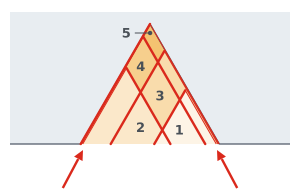
Infeed is the movement that takes the insert deeper on the next pass. Its direction determines which insert edge cuts and how the chip flows. In the diagrams, red lines show successive positions of the insert tip, and the arrow shows the infeed direction. The numbers 1–5 and progressively darker bands indicate successive passes, or the layers of material removed in each pass. The bold line shows the insert edge that is cutting.
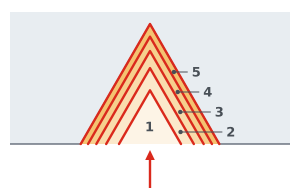
Radial infeed
The insert feeds straight toward the axis and cuts with both edges. This is the simplest method. It works well for fine pitches, short-chipping materials and hardened materials.
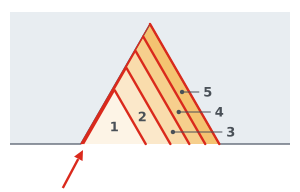
Modified flank infeed
The tool moves diagonally along the flank, or side of the profile, at an angle a few degrees less than 30°. One edge does most of the cutting, while the other does not rub against the thread flank. Manufacturers recommend this method as the first choice for most threads.
Alternating flank infeed
The tool alternately moves along each flank of the profile, so both edges wear evenly. This method helps with coarse pitches and long-chipping materials. It requires a program that is not available on every lathe.
Select the number of passes according to the pitch and material. For a pitch of 4 mm, insert manufacturers' catalogs specify 10–20 or 11–18 passes; harder materials require more passes. The first pass is the deepest, and each subsequent pass is shallower, keeping the chip cross section similar. The final pass should not be shallower than approximately 0.05 mm, or the edge will start rubbing instead of cutting.
SEL 32X32 22 – questions about selection and applications
Key information before selecting a holder
The holder accepts left-hand external threading inserts from the 22 EL family, such as 22 EL N60 and 22 EL N55. It also accepts 22 IR inserts with the same shape, such as the partial-profile 22 IR N60. Select the profile, pitch, and grade suitable for the application.
Up to 5.5 mm for metric threads, for example M56 x5.5 with a 22 EL 5.5 ISO insert. The 22 EL N60 and 22 EL N55 inserts cover pitches of 3.5–5 mm, or 7–5 threads per inch.
Yes, after installing a 22 EL TR insert. The holder can cut Tr trapezoidal threads with pitches of 4–5 mm, such as Tr 20x4 or Tr 24x5. The trapezoidal profile has an angle of 30°.
With full-profile 22 EL inserts, you can cut coarse threads from M30 x3.5 to M60 x5.5. For example, M36 x4 requires a 22 EL 4 ISO insert, while M48 x5 requires an 22 EL 5 ISO insert.
Product accessories


Reviews
No customer reviews for the moment.
Shipping
All orders are delivered by courier company GLS. For orders exceeding 369 PLN gross shipping is FREE
| Courier GLS | Przelew24 / Prepayment | 14,76 zł gross | Delivery time 1 working day |
| Courier GLS | Cash on delivery | 17,26 zł gross | Lead time 1 working day |
Recommended for you


This website uses its own and third-party cookies to improve our services and show you advertising related to your preferences by analyzing your browsing habits. To give your consent to its use, press the Accept button.
Cookie preferences
Functional cookiesTechnical
Functional cookies are strictly necessary to provide the services of the shop, as well as for its proper functioning, so it is not possible to refuse their use. They allow the user to browse through our website and use the different options or services that exist on it.
Advertising Cookies
These are cookies that collect information about the advertisements shown to users of the website. They can be anonymous, if they only collect information about the advertising spaces shown without identifying the user, or personalised, if they collect personal information about the user of the shop by a third party, for the personalisation of these advertising spaces.
Analytics cookies
Collect information about the user's browsing experience in the shop, usually anonymously, although sometimes they also allow the user to be uniquely and unequivocally identified in order to obtain reports on the user's interests in the products or services offered by the shop.