





- 98% satisfied customers
- 72h delivery
- 30 dni na zwrot

Description
Diameter50 mm
Depth of cutup to 10 mm
Inserts6 × APKT 1003
Coolant supplythrough the tool
Ø50 mm milling head – 90° for APKT 1003 inserts
Technical data and dimensions – Smoxh TK90 AP10, mounting bore 22 mm
| Technical data | |
|---|---|
| Head diameter D | 50 mm |
| Mounting bore d | 22 mm |
| Head height L | 40 mm |
| Max. depth of cut a | 10 mm |
| Entering angle | 90 degrees |
| Number of inserts Z | 6 |
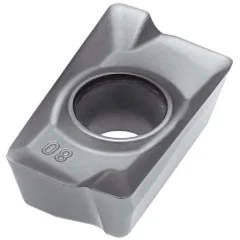
| Inserts | APKT 1003, e.g., APKT 100305 |
| Coolant supply | internal (H) |
| Insert screw | M2.5x6, Torx T08, 1.0 N·m |
| Mounting screw | M10, 7 mm hex key |
| Manufacturer | Smoxh, Turkey (SM29293) |
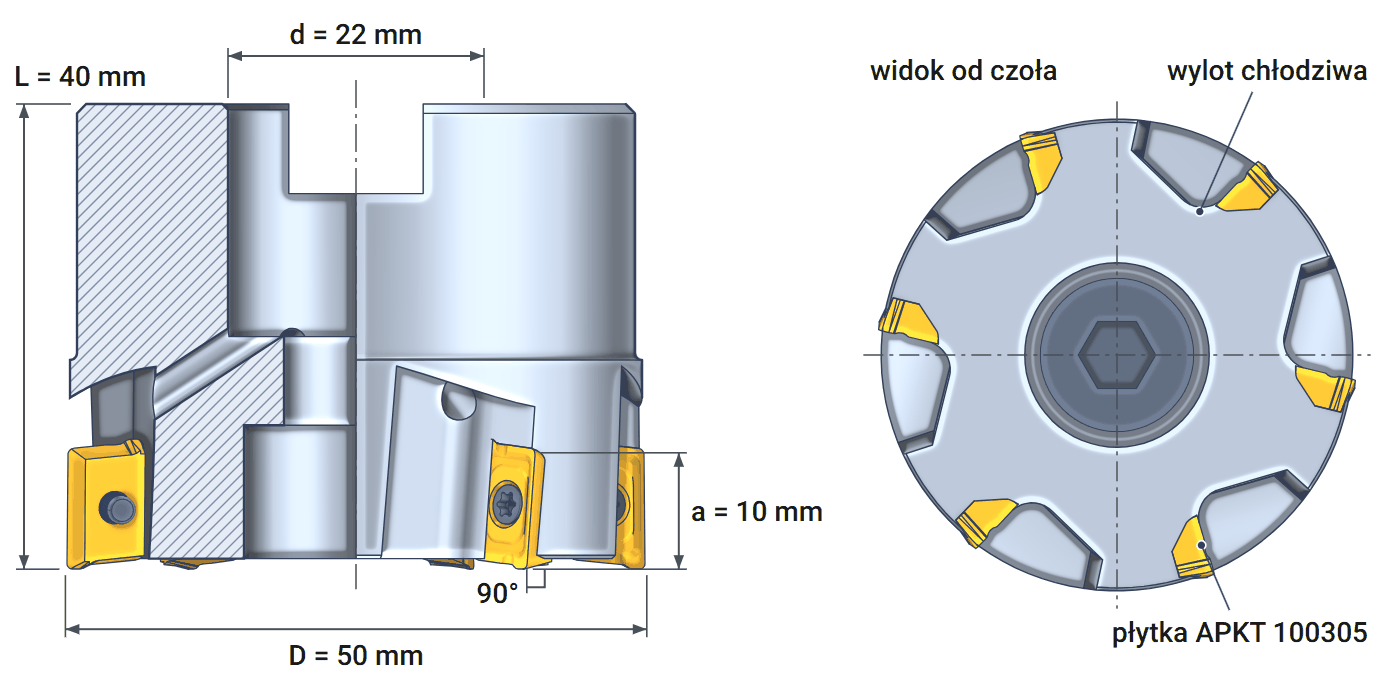
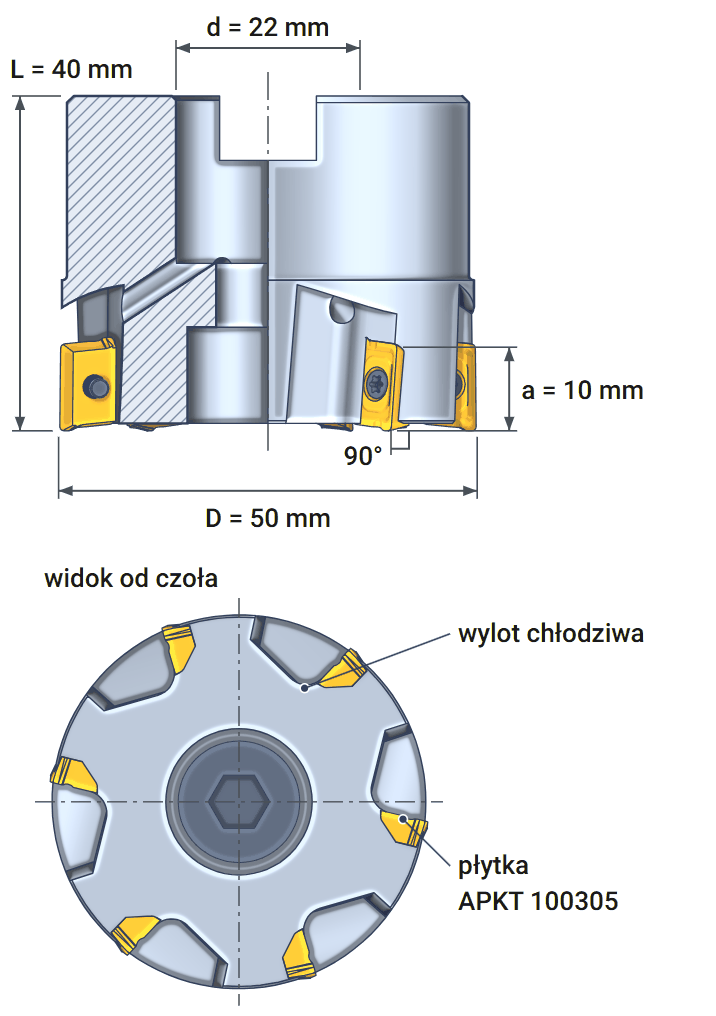
Ø50 mm milling head The Smoxh TK90 AP10 cuts at 90° with six APKT 1003 inserts. This milling head for metal face mills flat surfaces and mills square shoulders, slots, and pockets. It machines steel, stainless steel, and aluminum. It removes up to 10 mm of material in one pass. When an edge becomes dull, index the insert and the milling head can continue cutting.
This is an arbor-mounted milling head: instead of a shank, it has a 22 mm bore with a transverse slot. It fits onto a milling arbor, and the arbor's two drive keys engage the slot and transmit torque. An M10 screw clamps the milling head against the arbor face. Internal coolant, indicated by the letter H in the designation, flows through the arbor and screw to each of the 6 inserts.
APKT 1003 inserts – material selection and replacement
The insert grade determines the workpiece material; the milling head stays the same
The TK90 AP10 milling head accepts APKT 1003 inserts conforming to ISO 1832. The letter A denotes a 85° parallelogram, in practice a rectangular insert. P denotes a 11° clearance angle: the insert has positive geometry and cuts freely. The number 10 indicates the cutting edge length in millimeters, and 03 the insert thickness. The final digits 05 indicate a corner radius of 0.5 mm.
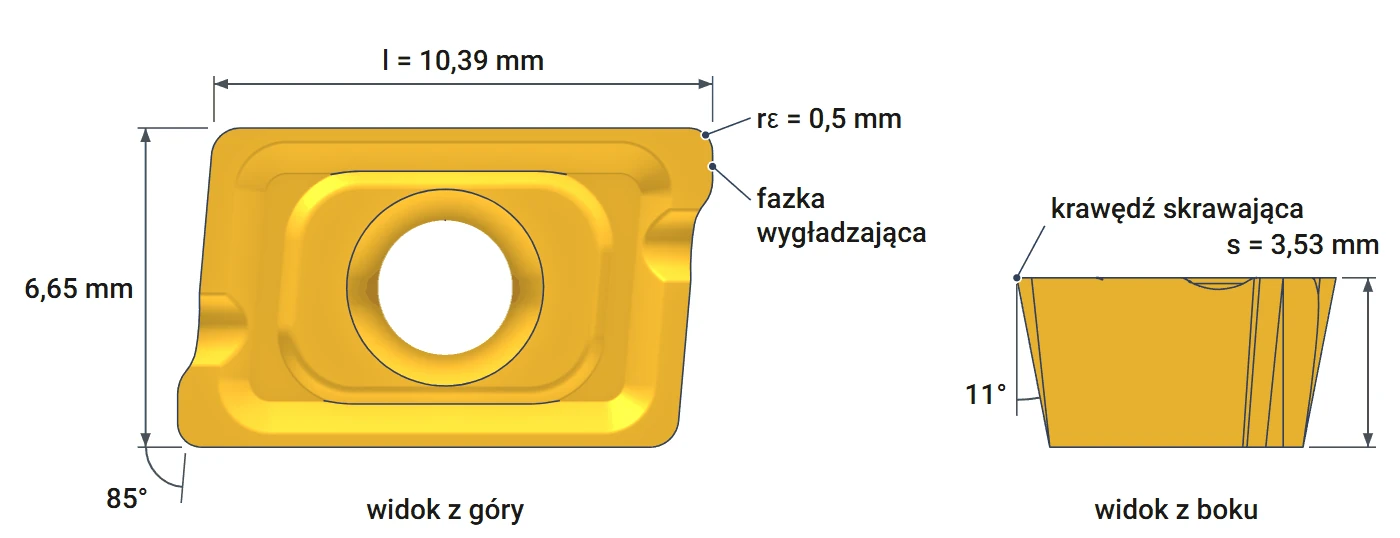
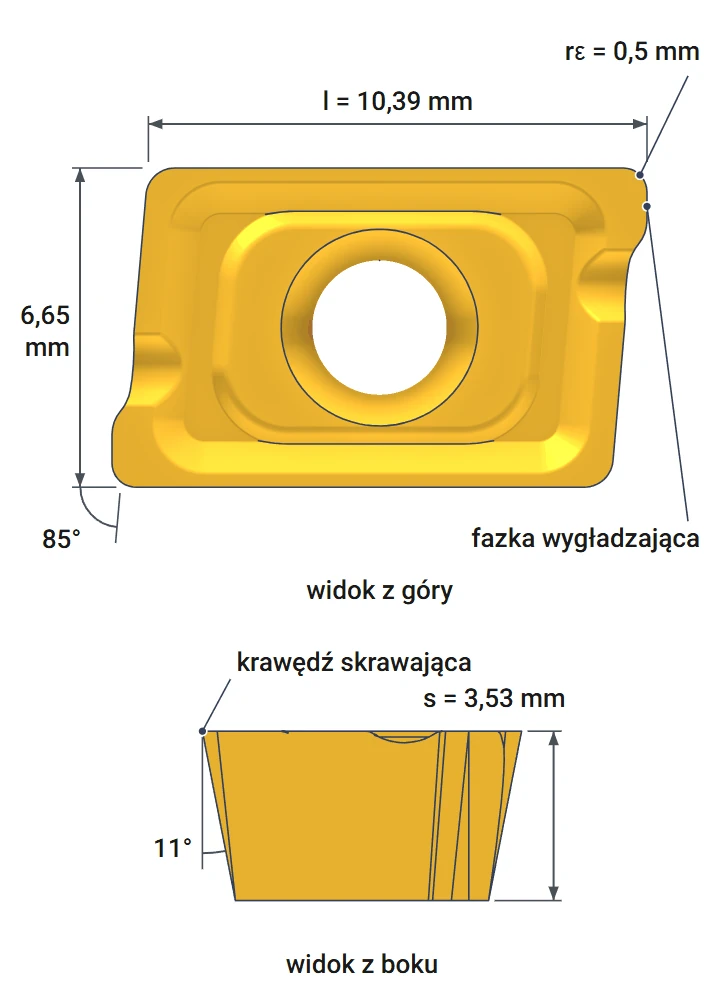
The drawing shows top and side views of the APKT 100305 insert. The cutting edge is 10.39 mm long, and the insert is 6.65 mm wide and 3.53 mm thick. The long edge produces the shoulder wall, while the short edge at the corner smooths the floor. The 6.65 mm width also defines the area without cutting edges at the center of the milling head.
| Insert | Workpiece material | Notes |
|---|---|---|
| APKT 100305 PDR H6310 Horn | steel, stainless steel | PVD coating |
| APKT 100305 PDFR K10 Horn | aluminum, nonferrous metals | grade K10 |
Horn is a Korean insert brand available in our store. Smoxh allows any ISO-compliant APKT 1003 insert in this milling head. To machine a different material, simply change the insert without replacing the milling head.
Replacing and indexing the insert
The drawing shows the milling head with two inserts removed from their pockets. Each insert is held by one M2.5x6 screw with a Torx T08 socket, threaded through the insert hole into the bottom of the pocket. Drawing numbers: 2 – milling head, 4 – insert, 5 – insert screw, 6 – Torx key.
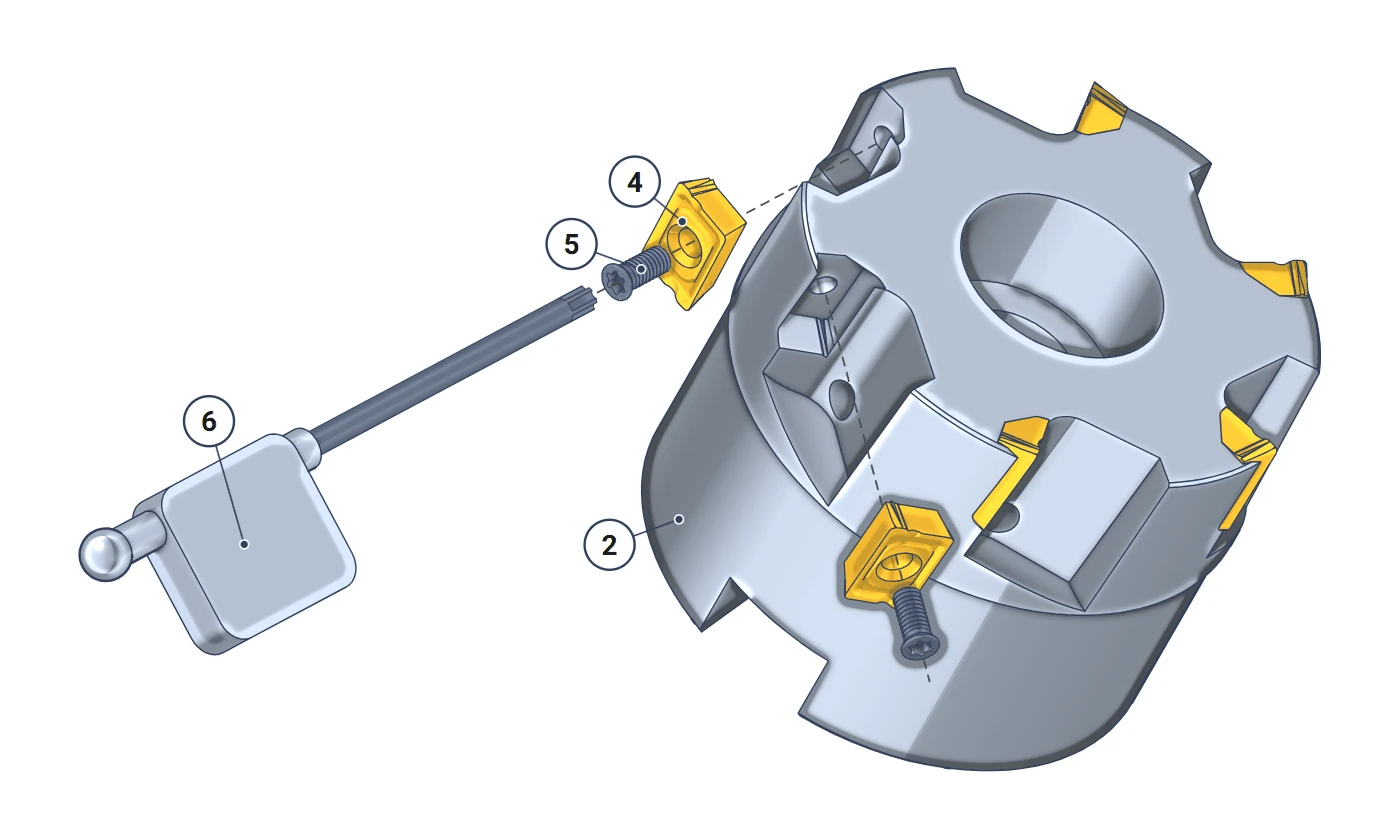
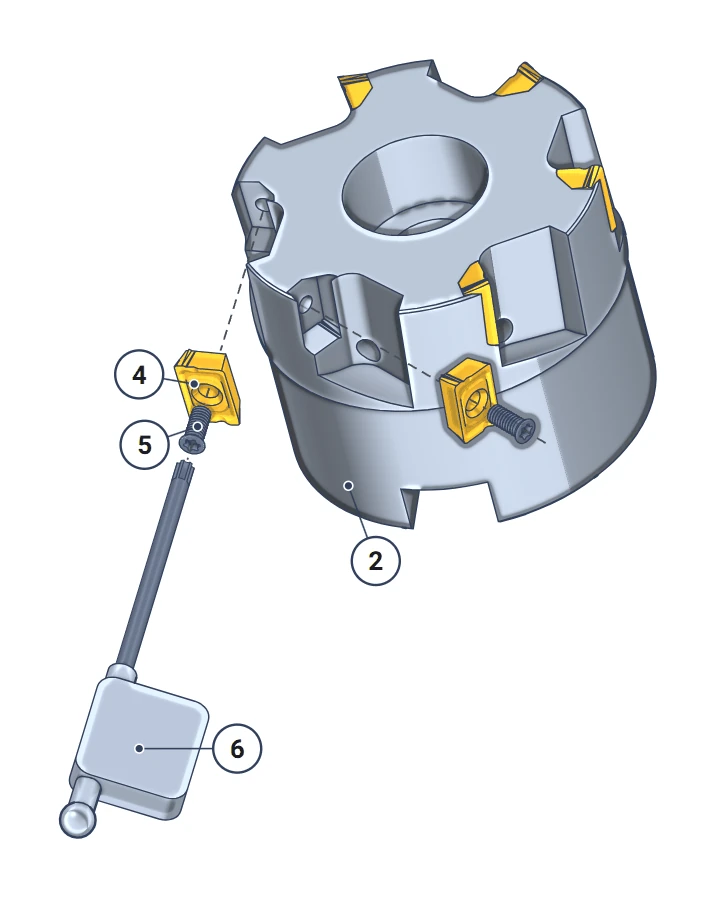
The insert has two cutting edges. When one becomes dull, loosen the screw with a T08 key and rotate the insert by 180°. Before installation, remove chips from the pocket – a chip under the insert lifts it and causes runout. Tighten the screw to the 1.0 N·m torque specified by Smoxh. Replace all 6 inserts together so they cut at the same height.
Six operations with a 90° milling head
Face milling, shoulder milling, slotting, ramping, helical milling, plunge milling
Smoxh lists face milling, shoulder milling, slotting, plunge milling, and helical interpolation for milling heads using APKT 1003 inserts. Each operation uses a different insert edge. The side edge, 10 mm long, produces the wall. The bottom edge smooths the floor and allows downward cutting. The drawings show the milling head movement and the material removed.
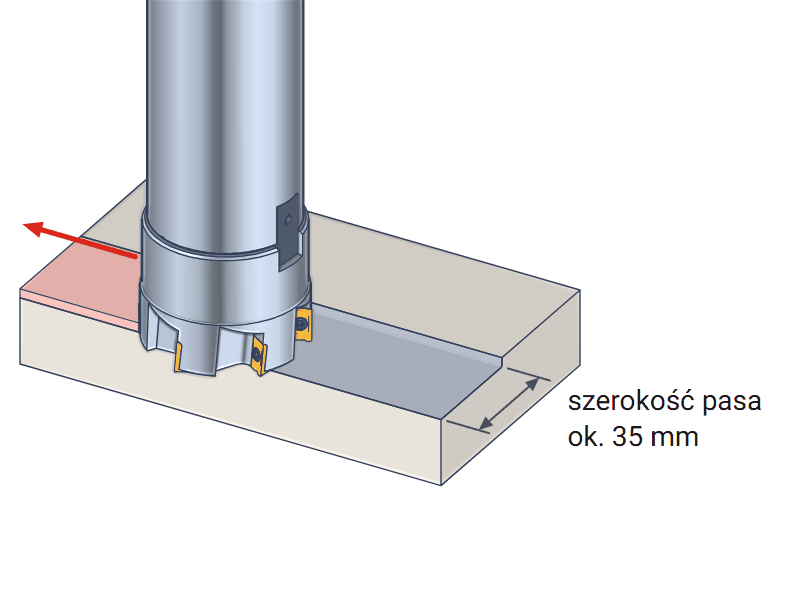
Face milling
The milling head passes over the workpiece at a shallow depth of cut. The bottom insert edge with a short chamfer at the corner smooths the surface. One pass removes a strip up to approximately 35 mm wide, or 70 % of the diameter. This is how the milling head face mills end faces, ledges, and castings.
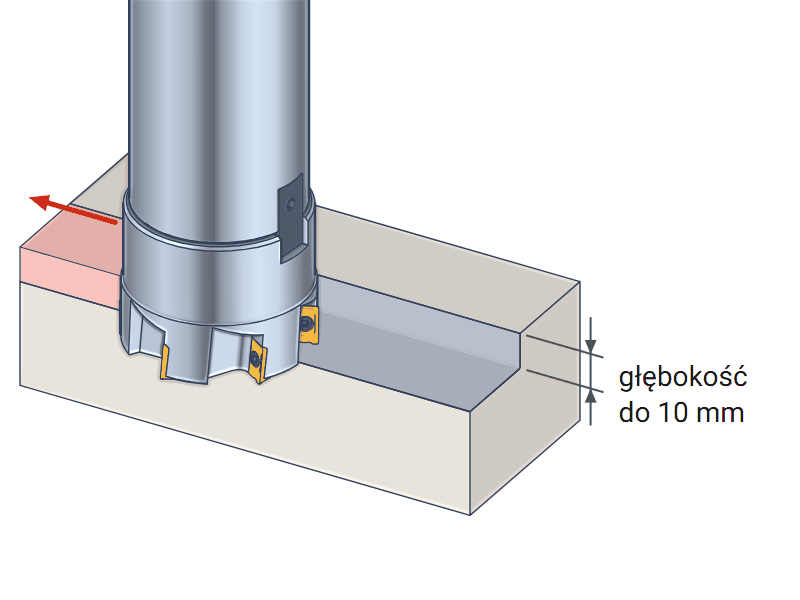
90° shoulder and contour
The side edge of the insert is parallel to the milling head axis. This produces a wall perpendicular to the floor. A shoulder height of up to 10 mm can be machined in one pass. A radius of 0.5 mm remains in the corner between the wall and floor, matching the insert corner radius.
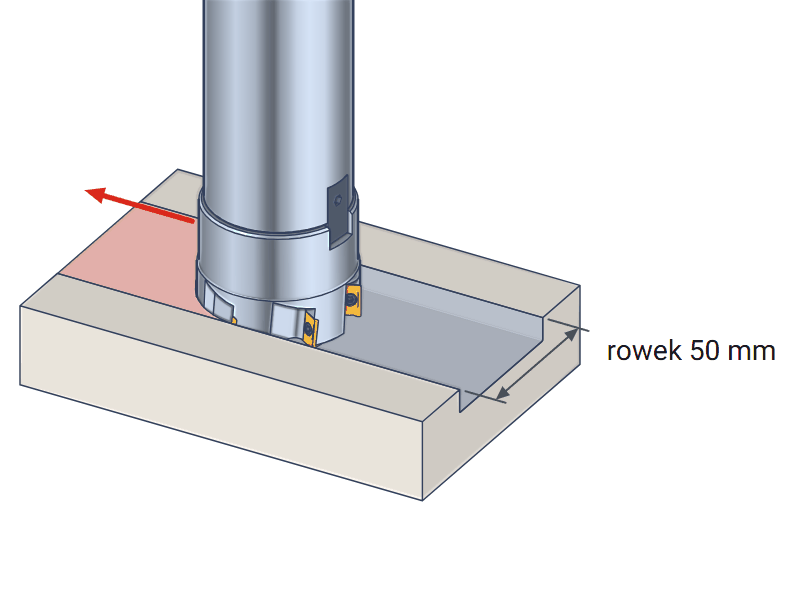
50 mm wide slot
The milling head moves through the middle of the material and cuts a 50 mm wide slot in one pass. The entire front of the milling head cuts, with three inserts engaged at once. The forces change direction, so use a lower depth of cut and feed than for shoulder milling.
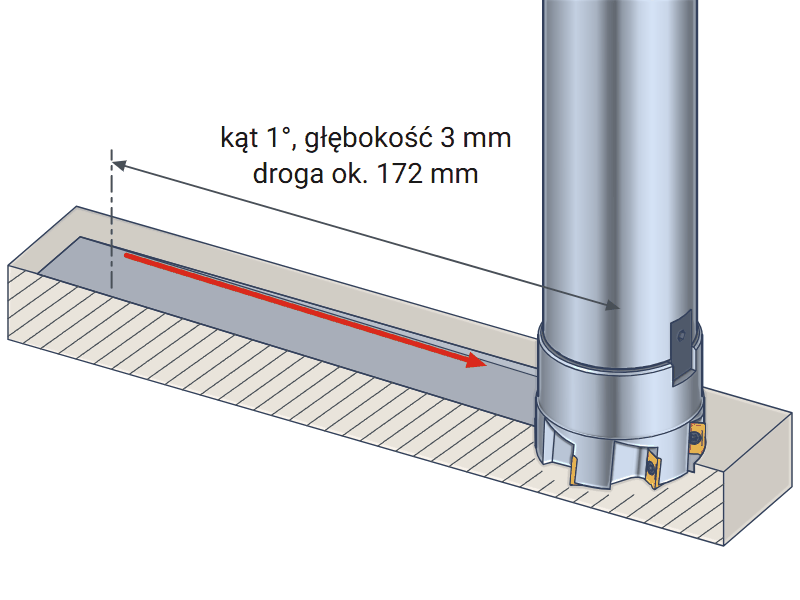
Ramping – angled entry
The milling head descends into the material along an inclined straight line while moving sideways. The bottom insert edge cuts downward, so a starter hole is not required. Smoxh does not specify a ramp angle – start with a small angle. At an angle of 1°, descending 3 mm requires approximately 172 mm of travel.
Helical interpolation – a hole without a drill
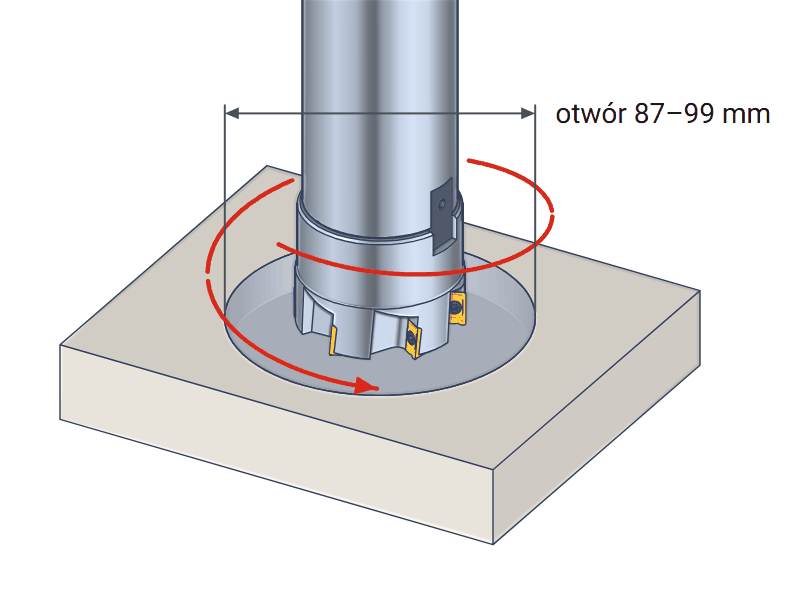
The milling head follows a circular path and descends with each revolution. This produces a flat-bottom hole from 87 to 99 mm in diameter. Set the hole diameter in the machine program. This also provides smooth entry into a closed pocket.
Plunge milling
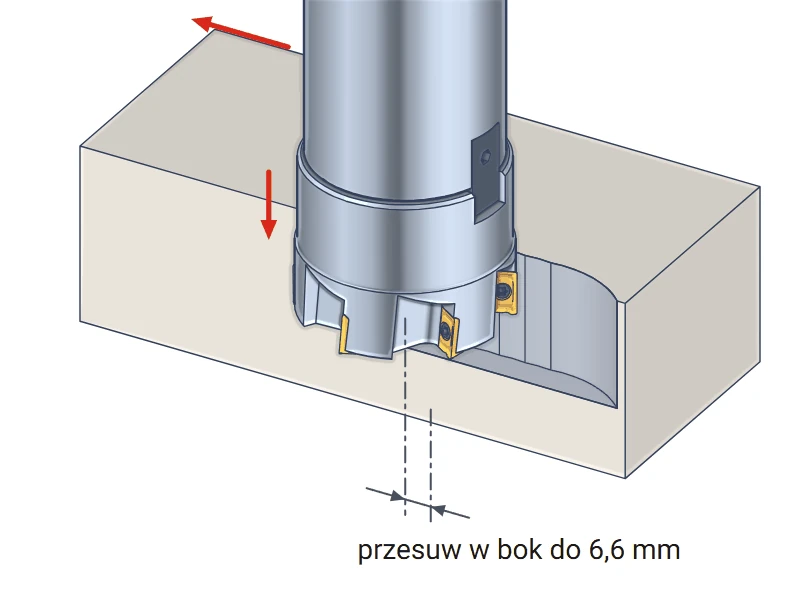
The milling head plunges axially downward, retracts, and steps sideways. Each plunge removes material only at the periphery. Keep the lateral stepover to approximately 6.6 mm or less – this is how far the insert extends inward from the periphery. The force then acts mainly along the axis.
Helically milled hole: from 87 to 99 mm
The bottom insert edge extends approximately 6.65 mm inward from the milling head periphery. It therefore ends 18.35 mm from the axis (25 − 6.65 mm). A 36.7 mm circular area without cutting edges remains at the center of the face. Minimum hole diameter = 50 + 2 × 18.35 ≈ 87 mm – in a smaller hole, a core remains beneath the milling head. Maximum flat-bottom hole diameter = 2 × 50 − 2 × 0.5 = 99 mm.
Calculation: helical pitch for a 90 mm hole
Calculate the pitch using the path of the milling head center, not the hole diameter. Path diameter = hole diameter 90 mm − milling head diameter 50 mm = 40 mm. One revolution covers a distance of 3.14 × 40 ≈ 125.7 mm. At a descent angle of 1°, the pitch is 125.7 × 0.0175 (tangent of 1°) ≈ 2.2 mm per revolution. The 1° angle is an example – Smoxh does not specify it. The pitch must not exceed 10 mm, which is the maximum depth of cut of the insert.
▲
The milling head cannot drill
The 36.7 mm circular area at the center of the face has no cutting edges. When plunging straight down into solid material, the core will contact the body and overload the inserts. Enter solid material by ramping or along a helical path. Axial entry is only possible over a hole at least 37 mm in diameter.
Cutting data – starting values for 6 inserts
Cutting speed, feed per tooth, spindle speed, and feed rate for a 50 mm milling head
The table provides conservative starting values for milling 90° shoulders with APKT inserts. Spindle speed and feed rate are calculated for a diameter of 50 mm and 6 inserts. Start with these values and increase them while monitoring the chips and spindle operation. Reduce the feed when slotting, ramping, and helical milling.
| Workpiece material | Insert | Cutting speed vc [m/min] | Feed per tooth fz [mm] | Spindle speed [rpm] | Feed rate [mm/min] | Max. depth of cut ap [mm] |
|---|---|---|---|---|---|---|
| P Structural and alloy steel | H6310 | 150 (130–200) | 0.10 (0.10–0.20) | 950 | 570 | 4 |
| M Stainless steel | H6310 | 90 (70–130) | 0.08 (0.06–0.15) | 570 | 280 | 2 |
| N Aluminum | K10 | 400 (300–600) | 0.10 (0.10–0.25) | 2550 | 1530 | 6 |
Spindle speed and feed rate calculation – steel, 150 m/min
Spindle speed = 1000 × cutting speed 150 m/min ÷ (3.14 × milling head diameter 50 mm) ≈ 950 rpm. Feed rate = feed per tooth 0.10 mm × 6 inserts × 950 rpm ≈ 570 mm/min. Enter these two values in the machine program. In aluminum, at 400 m/min, the spindle speed rises to approximately 2550 rpm.
Ø50 mm milling head The Smoxh TK90 AP10 face mills and mills 90° shoulders, slots, and pockets in steel, stainless steel, and aluminum. It helically mills holes from 87 to 99 mm in diameter. It uses six APKT 100305 inserts, mounts on a drive-key arbor with a 22 mm pilot, and has internal coolant. The maximum depth of cut is 10 mm.
Questions about the TK90 AP10 D50 milling head
Arbor, inserts, coolant, holes
A drive-key arbor with a 22 mm pilot and two 10 mm drive keys, such as SK40 conforming to DIN 69871-A (7369 40-22-60) or BT40 conforming to MAS 403-BT. The keys engage the transverse slot in the milling head and transmit torque. An M10 screw threaded into the arbor pilot clamps the milling head.
APKT 1003 inserts conforming to ISO, such as APKT 100305 with a 0.5 mm corner radius. Grade H6310 from the Korean brand Horn is suitable for steel and stainless steel, and K10 for aluminum. Each insert is secured by an M2.5x6 screw with a Torx T08 socket, tightened to 1.0 N·m.
Coolant flows through the center of the arbor and the hole in the STV-C M10 mounting screw. From the chamber behind the screw, 6 channels direct it to each insert. The coolant system works when the spindle and arbor provide a through-coolant supply.
Approximately 87 mm. In a smaller hole, a core remains beneath the center of the face because the 36.7 mm circular area at the center of the milling head has no cutting edges. The largest flat-bottom hole produced in a single helical path is 99 mm in diameter.
Product accessories


Carbide insert APKT 100305 PDR H6310 Horn
Reference: 899652 In stock > 10 items
€3.16
€3.88 brutto

Reviews
No customer reviews for the moment.
Shipping
All orders are delivered by courier company GLS. For orders exceeding 369 PLN gross shipping is FREE
| Courier GLS | Przelew24 / Prepayment | 14,76 zł gross | Delivery time 1 working day |
| Courier GLS | Cash on delivery | 17,26 zł gross | Lead time 1 working day |
Recommended for you


This website uses its own and third-party cookies to improve our services and show you advertising related to your preferences by analyzing your browsing habits. To give your consent to its use, press the Accept button.
Cookie preferences
Functional cookiesTechnical
Functional cookies are strictly necessary to provide the services of the shop, as well as for its proper functioning, so it is not possible to refuse their use. They allow the user to browse through our website and use the different options or services that exist on it.
Advertising Cookies
These are cookies that collect information about the advertisements shown to users of the website. They can be anonymous, if they only collect information about the advertising spaces shown without identifying the user, or personalised, if they collect personal information about the user of the shop by a third party, for the personalisation of these advertising spaces.
Analytics cookies
Collect information about the user's browsing experience in the shop, usually anonymously, although sometimes they also allow the user to be uniquely and unequivocally identified in order to obtain reports on the user's interests in the products or services offered by the shop.