 Polski





- 98% satisfied customers
- 72h delivery
- 30 dni na zwrot

Description
Hand tap G 3/8 inch left-hand for pipes
| Technical data | ||
|---|---|---|
| Nominal diameter d1 inches/mm | G 3/8 in | 16.66 mm |
| Thread pitch P inches/mm | 19 threads per inch | 1.337 mm |
| Overall length l1 | 70 mm | |
| Flute length l2 | 22 mm | |
| Shank diameter d2 | 12 mm | |
| Square drive size a | 9 mm | |
| Tap drill diameter | 15.25 mm | |
| Form C chamfer | No. 1: 5P, No. 2: 2P | |
| Thread angle G | 55° | |
| Thread standard | BSP DIN ISO 228 | |

Roughing tap and finishing tap – how much material each removes
Division of work in the 1–2 set
The G 3/8 LH thread is cut into the wall of a hole with a diameter of 15.25 mm. The thread groove extends 0.71 mm into the wall. A single tap would have to cut the entire groove at once – by hand, this means high resistance and a risk of breakage. The set divides this work into two passes.


The drawing shows the entire set in operation. Both taps have the same shank and the same length. They differ in their chamfer, the tapered tip: No. 1 has a chamfer spanning 5 threads, while No. 2 spans only 2 threads. The detail windows at the hole wall show how the thread groove deepens after each tap.
| Tap | Chamfer | Chamfer angle | Material removed | How it works in the hole |
|---|---|---|---|---|
| No. 1 – roughing tap | long, 5 threads | 7° | the main portion of the groove | enters smoothly and establishes thread alignment |
| No. 2 – finishing tap | short, 2 threads | 20° | the remainder, to the full profile | screws into the previously cut threads and produces the full thread profile |
How to distinguish the taps in the set
The chamfer on No. 1 is 2.5 times as long as the chamfer on No. 2 – the difference is immediately visible when you place them side by side. No. 1 has an incomplete thread profile; only No. 2 has the full profile. The number is also indicated on the shank: No. 1 has one ring, No. 2 has none. Keep the set together and always start with the roughing tap.
How to tap a G 3/8 LH hole – sequence 1, 2
Hand tapping step by step
Thread G 3/8 LH in four steps
ØDrilling
Drill bit 15.25 mm
1Roughing tap
Chamfer 5 threads
2Finishing tap
Chamfer 2 threads
✓Finished thread
Thread G 3/8 LH
Turning sequence: half a turn counterclockwise, a quarter turn clockwise | Between taps: remove chips from the hole
Start with the hole. The G thread has a Whitworth profile, with a thread height of 0.64 times the pitch. The minor diameter of the internal thread is the 16.662 mm diameter minus twice the thread height, or 1.28 × the 1.337 mm pitch: the result is 14.95 mm. ISO 228-1 permits a hole diameter from 14.95 to 15.395 mm, and a 15.25 mm drill falls within this range. An undersized hole is a common cause of taps twisting off in the material.
Through hole or blind hole – how deep to drill
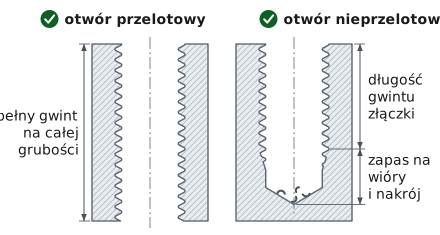
The set taps both types of holes. In a through hole, the thread extends through the full material thickness. In a blind hole, cut the thread to match the thread length of the fitting being installed. Drill the hole deeper than the thread. The finishing tap has a 2-thread chamfer, so approximately 2 incomplete threads remain near the bottom. The extra depth below the thread accommodates these along with the chips.
No. 1 – the roughing tap establishes thread alignment
Fit the roughing tap into a tap wrench and position it perpendicular to the surface. Check the angle from two sides, for example with a square. This is a left-hand thread, so turn in the opposite direction to usual: half a turn counterclockwise, then a quarter turn clockwise. Reversing breaks the chip into short pieces — a slight crunch is normal. The first threads determine whether the thread will be straight.
No. 2 – the finishing tap produces the full profile
Back out the roughing tap and remove chips from the hole. Screw the finishing tap by hand into the previously cut threads – it should engage them naturally. Continue turning with the same rhythm used for the roughing tap. The finishing tap removes the remaining material and cuts the groove to its full profile. When it screws in smoothly all the way, the thread is finished – check it with a G 3/8 LH thread plug gauge: the GO end screws in by hand over the full length, while the NO-GO end enters no more than 2 threads.
Hand tap G 3/8 inch left-hand for pipes
Hand Tap 3/8 inch left-hand G DIN 5157/2 HSS is a specialized two-piece set (roughing tap + finishing tap) designed for manually cutting G parallel pipe threads (BSP – British Standard Pipe) o left-hand thread direction. The tool is made from high-grade high-speed steel (HSS), guaranteeing high durability, wear resistance and precise thread guidance.
The G 3/8 inch thread has an outside diameter of 16.662 mm (in accordance with ISO 228-1) and a profile with a 55° thread angle. The left-hand thread direction is used in applications including hydraulic, pneumatic and gas systems where the thread must prevent connections from loosening on their own.
Left-hand inch tap G 3/8 for pipes is an excellent choice for precision service and production tasks, both in industrial installations and in metalworking.
- 2-piece set (DIN 5157/2) – roughing tap and finishing tap provide gradual, controlled tapping.
- Left-hand G 3/8 inch thread – thread outside diameter 16.662 mm.
- 55° profile – compliant with the BSP pipe thread standard.
- HSS high-speed steel – abrasion-resistant, ideal for steel, non-ferrous metals and plastics.
- For manual applications – in gas, hydraulic and industrial systems.
Hand Tap G 3/8 inch left-hand is a reliable tool for specialists who value precision, durability and full compliance with industrial G pipe thread standards.
Stages of cutting a G 3/8 inch thread with a 2-piece set: roughing and finishing taps

Frequently asked questions
The question “how many mm is G 3/8 inch” or “how many cm is G 3/8 inch” often comes up when selecting pipe threading tools. Contrary to what it may seem, the value 3/8 inch (i.e., 16.66 mm or 1.66 cm) does not indicate the thread diameter, but the nominal size of the pipe that the thread fits. In practice, G 3/8 inch tap has an outside diameter of 16.66 mm, because G (BSP) pipe threads are designed for thick-walled pipes.
For this reason, always check the thread diameter in the technical data instead of converting inches directly to millimeters. In the BSP system, thread size is determined by the design of the entire installation, not just the nominal dimension.
No. A G (BSP) thread is a parallel pipe thread, meaning its diameter is constant along its entire length. Unlike taper threads (designated R or BSPT), G threaded connections are not self-sealing. This means that a G thread does not provide a seal on its own – it requires an additional sealing element, e.g. a flat gasket, O-ring or plastic washer. This sealing method is commonly used in hydraulic, pneumatic and industrial installations.
Product accessories


Reviews
No customer reviews for the moment.
Shipping
All orders are delivered by courier company GLS. For orders exceeding 369 PLN gross shipping is FREE
| Courier GLS | Przelew24 / Prepayment | 14,76 zł gross | Delivery time 1 working day |
| Courier GLS | Cash on delivery | 17,26 zł gross | Lead time 1 working day |
Recommended for you




This website uses its own and third-party cookies to improve our services and show you advertising related to your preferences by analyzing your browsing habits. To give your consent to its use, press the Accept button.
Cookie preferences
Functional cookiesTechnical
Functional cookies are strictly necessary to provide the services of the shop, as well as for its proper functioning, so it is not possible to refuse their use. They allow the user to browse through our website and use the different options or services that exist on it.
Advertising Cookies
These are cookies that collect information about the advertisements shown to users of the website. They can be anonymous, if they only collect information about the advertising spaces shown without identifying the user, or personalised, if they collect personal information about the user of the shop by a third party, for the personalisation of these advertising spaces.
Analytics cookies
Collect information about the user's browsing experience in the shop, usually anonymously, although sometimes they also allow the user to be uniquely and unequivocally identified in order to obtain reports on the user's interests in the products or services offered by the shop.