 Polski





- 98% satisfied customers
- 72h delivery
- 30 dni na zwrot

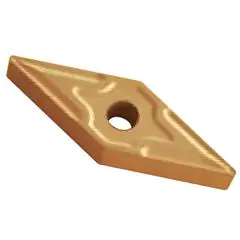
Carbide insert VNMA 160404 WAK10 Walter
0000008740
€5.83 tax inc.
Net price: €4.74
Description
VNMA 160404 turning insert – indexable 35° rhombus for cast iron
| Technical data | |
|---|---|
| Side length l | 16.5 mm |
| Insert thickness s | 4.76 mm |
| Hole diameter d1 | 3.81 mm |
| Corner radius rε | 0.4 mm |
| ANSI code | VNMA 331 |
| Inscribed circle diameter IC | 9.525 mm |
WAK10 indexable carbide insert – applications and design
double-sided 35° rhombus with a hole, geometry without a chip breaker
The VNMA 160404 turning insert is a double-sided indexable insert made of grade WAK10 cemented carbide, designed for turning cast iron. Shape V, a rhombus with a 35° corner angle, facilitates profile turning and machining of contours with widely varying profiles. Negative geometry with a 0° clearance angle allows both sides of the insert to be used — a total of four cutting edges. The flat rake face without a chip breaker (type A according to ISO 1832) and the small nose radius rε of 0.4 mm make the insert suitable for finish machining of short-chipping cast iron.
Key advantages of the WAK10 cemented carbide insert
- Four cutting edges — 2 sharp corners on each of the two sides reduce the cost per cutting edge compared with single-sided inserts.
- Grade WAK10 for cast iron — cemented carbide designed for turning cast iron, including under very severe and interrupted cutting conditions.
- Sharp 35° tip — facilitates profile turning and access to corners with varying workpiece profile angles.
- The nose radius rε of 0.4 mm makes the insert suitable for finish machining at low feed rates and a good surface finish.
- Tolerance class M provides repeatable cutting edge positioning after indexing the insert in the holder pocket.
- Dimensions according to ISO 1832: side length 16.5 mm, IC 9.525 mm (3/8″), thickness 4.76 mm — fit holders with a rhombic pocket, size 16.
Applications and cutting data selection for the diamond-shaped insert
The VNMA 160404 insert (also written without a space as vnma160404) is suitable for longitudinal and profile turning of cast iron components — bushings, pulleys, pump bodies and gearbox housings. The sharp 35° tip reduces radial forces and facilitates access to corners with varying profile angles, reducing vibration on slender workpieces. Calculate spindle speed using n = 1000·Vc/(π·D): for a shaft diameter of 80 mm at an example cutting speed of Vc = 120 m/min, the result is approximately 478 rpm. The small nose radius rε of 0.4 mm favors finish machining at low feed rates, where surface finish matters. The sharp profile is also suitable for profile turning with varying angles, where an insert with a larger corner angle could not reach the bottom of a recess.
Cemented carbide grade WAK10 was developed for machining cast iron, including under very severe and interrupted cutting conditions. The flat rake face without a formed chip breaker works well with the short, brittle chips of cast iron, which break on their own. Indexable inserts in this series are supplied by the German manufacturer Walter. When machining cast iron, cut dry or use an air blast to reduce thermal shock at the cutting edge. Also check the radial runout of the chuck — uneven stock allowance on the casting increases impact loads on the cutting edge.
▲
Application limitation
Type A geometry with a flat rake face has no formed chip breaker — it works well in short-chipping cast iron, but for long-chipping steel and stainless steel, choose an insert with a chip breaker, such as version VNMG 160404.
Rhombic insert designation decoder according to ISO 1832
how to read the VNMA 160404 code — positions 1–7 of the designation
Designation VNMA 160404 according to the standard ISO 1832: 4 letters describe geometry and construction, 3 numeric codes describe dimensions. Each field has a number, an icon, and a brief description.
Frequently asked questions about the VNMA 160404 insert
number of edges, materials and holder selection
Four — the 35° diamond has 2 corners per side, and the negative geometry (clearance angle 0°) allows both sides of the insert to be used. When a corner becomes dull, simply index the insert in the pocket without changing the holder.
WAK10 cemented carbide is designed for machining cast iron, including under very severe and interrupted cutting conditions. The flat rake face without a chip breaker works well with the short, brittle chips of cast iron, which break on their own.
The radius 0.4 mm is the version for finish machining at low feed rates and an improved surface finish. Larger radii (0.8 mm for general use, 1.2 mm for roughing) increase corner strength at the expense of higher cutting forces. The remaining dimensions of the family — IC 9.525 mm and thickness 4.76 mm — are identical.
In turning tool holders with a size 16 V-shaped rhombic pocket (IC 9.525 mm) — for external longitudinal and profile turning, and in boring bars for internal turning. The sharp 35° angle allows contours with widely varying profiles to be machined without changing tools.
Reviews
No customer reviews for the moment.
Shipping
All orders are delivered by courier company GLS. For orders exceeding 369 PLN gross shipping is FREE
| Courier GLS | Przelew24 / Prepayment | 14,76 zł gross | Delivery time 1 working day |
| Courier GLS | Cash on delivery | 17,26 zł gross | Lead time 1 working day |
Recommended for you





Viewed products


This website uses its own and third-party cookies to improve our services and show you advertising related to your preferences by analyzing your browsing habits. To give your consent to its use, press the Accept button.
Cookie preferences
Functional cookiesTechnical
Functional cookies are strictly necessary to provide the services of the shop, as well as for its proper functioning, so it is not possible to refuse their use. They allow the user to browse through our website and use the different options or services that exist on it.
Advertising Cookies
These are cookies that collect information about the advertisements shown to users of the website. They can be anonymous, if they only collect information about the advertising spaces shown without identifying the user, or personalised, if they collect personal information about the user of the shop by a third party, for the personalisation of these advertising spaces.
Analytics cookies
Collect information about the user's browsing experience in the shop, usually anonymously, although sometimes they also allow the user to be uniquely and unequivocally identified in order to obtain reports on the user's interests in the products or services offered by the shop.