






Net price: €16.32
Description
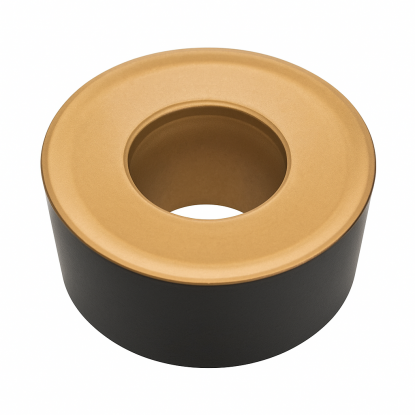
round shape with a full radius, countersunk hole, and chip breaker
| Technical data | |
|---|---|
| Insert diameter d | 16 mm |
| Insert thickness s | 6.35 mm |
| Hole diameter d1 | 5.5 mm |
single-sided RCMT insert for profile and copy turning of steel
The RCMT 1606 turning insert is a round indexable insert made of grade PH 5125 cemented carbide, designed for turning steel. Shape R denotes a continuous peripheral cutting edge without corners — any section of the circle can engage in cutting. The positive clearance angle (letter C, α = 7°) makes the insert single-sided, secured in its seat with a screw through a countersunk hole. The round cutting edge acts as one large nose radius, providing a smooth surface and a strong cutting edge during profile and copy turning.
The RCMT 1606 insert (also written without a space as rcmt1606) is suitable for profile turning, copy turning, and machining radii on shafts and components made of structural steels. Calculate spindle speed using n = 1000·Vc/(π·D): for a shaft diameter of 50 mm at an example speed of Vc = 200 m/min, the result is approximately 1273 rpm. Select the depth of cut carefully — the greater the ap, the longer the contact between the round cutting edge and the material, and the higher the radial forces. Indexable inserts in grade PH 5125 are supplied by the manufacturer Palbit.
In grade PH 5125, the insert is used for longitudinal and profile turning of structural and engineering steels. Due to inconsistent catalog data in the source, confirm the exact ISO application groups and coating type in the manufacturer's data sheet before setting the cutting speed. The reduced chip thickness at a given depth of cut distributes the load over a longer section of the cutting edge, promoting uniform wear and longer tool life. This force distribution can also be beneficial in interrupted cutting, where the round edge enters the material gradually.
The positive geometry of the RCMT insert reduces cutting resistance and facilitates machining of thin-walled workpieces and those prone to vibration. The round cutting edge can be used in several positions: after one section wears out, simply rotate the insert through a small angle until the entire circumference has been used. When turning steel, maintain a uniform feed rate and continuous coolant flow to limit built-up edge and extend cutting edge life.
The round insert has a large, variable entering angle and a long contact length with the material, which increases radial forces and the risk of vibration on slender, poorly supported workpieces. Limit the depth of cut and ensure rigid clamping of the workpiece and holder.
how to read the RCMT 1606 code — positions 1–6 of the designation
Designation RCMT 1606 according to the standard ISO 1832: 4 letters describe geometry and construction, 2 numeric codes describe dimensions. Each field has a number, an icon, and a brief description.
design, materials, and applications of the round insert
A round insert has no distinct corners — any section of its continuous peripheral edge can cut. This allows a single insert to be indexed multiple times: after a section wears out, it is rotated through a small angle in its seat. Letter C (α = 7°) denotes single-sided geometry, so only one side of the insert is used.
Grade PH 5125 is designed for turning steel — in longitudinal and profile turning operations. The source catalog data is inconsistent (mixing the designation with 5115), so the exact ISO application groups and coating type should be confirmed in Palbit's manufacturer data sheet before selecting cutting parameters.
The round cutting edge acts as one large nose radius, providing a smoother surface and a stronger cutting edge than inserts with sharp corners, such as triangular or diamond-shaped inserts. In return, it has a longer contact length with the material and higher radial forces, requiring rigid clamping and careful selection of the depth of cut.
It performs best in profile and copy turning, machining radii at diameter transitions, and turning profiles on steel shafts. It is secured with a screw through a countersunk hole in holders with a round insert seat with a diameter of 16 mm; the positive geometry facilitates machining of thin-walled workpieces.
No customer reviews for the moment.
All orders are delivered by courier company GLS. For orders exceeding 369 PLN gross shipping is FREE
| Courier GLS | Przelew24 / Prepayment | 14,76 zł gross | Delivery time 1 working day |
| Courier GLS | Cash on delivery | 17,26 zł gross | Lead time 1 working day |
This website uses its own and third-party cookies to improve our services and show you advertising related to your preferences by analyzing your browsing habits. To give your consent to its use, press the Accept button.


