






Description
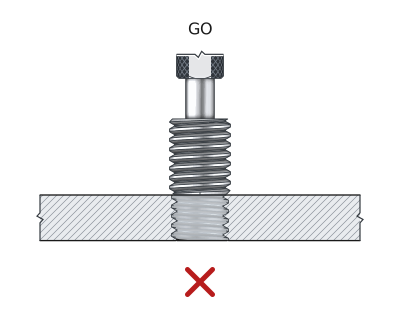
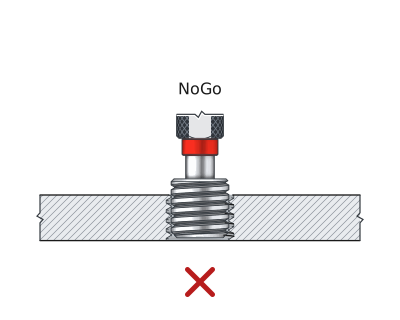
What each end of the gauge detects
| TECHNICAL DATA | |
|---|---|
| Thread type | Unified inch fine thread UNF |
| Thread size | 7/8-14 |
| Threads per inch | 14 TPI |
| Thread pitch | 1.814 mm |
| Nominal diameter | 22.225 mm |
| Tolerance class | 2B |
| Pitch diameter D2 | 21.046 – 21.224 mm |
| Hole minor diameter D1 | 20.262 – 20.663 mm |
| Gauge type | Double-ended: GO + NO-GO |
| Material | Tool steel, hardened |
| Hardness | 58-62 HRC |
| Standard | ASME B1.1 / ASME B1.2 |
| Manufacturer | Varel |
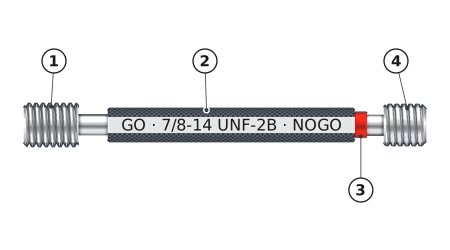
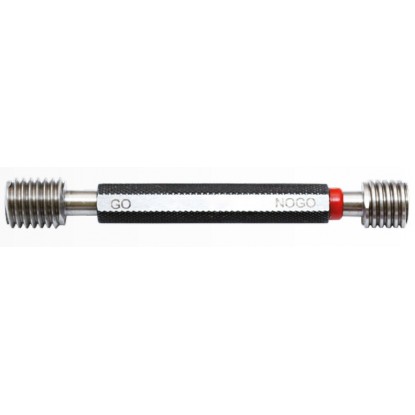
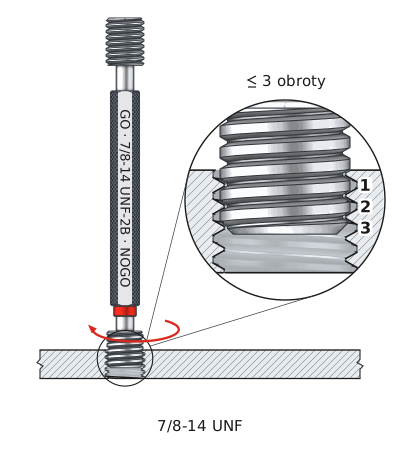
UNF 7/8-14 thread plug gauge checks an internal thread against both limits at once. The GO end corresponds to maximum material, the NO-GO end to minimum material. The acceptance criterion comes from ASME B1.2: the NO-GO end may enter no more than three full turns.
The seven-eighths-inch fine thread is used on a dash -10 ORB O-ring port and a JIC fitting of the same size, intended for a 5/8-inch hose. It is one of the most commonly machined threads in mobile and industrial hydraulic bodies — in control valves, pumps, and valve blocks.
Two limits of the tolerance zone per ASME B1.2
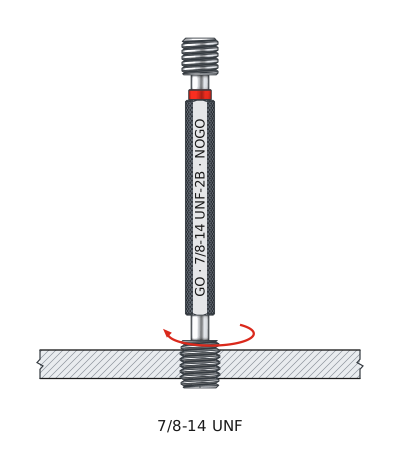
Screwed in by hand — enters to the full depth
Screwed in by hand — no more than 3 full turns
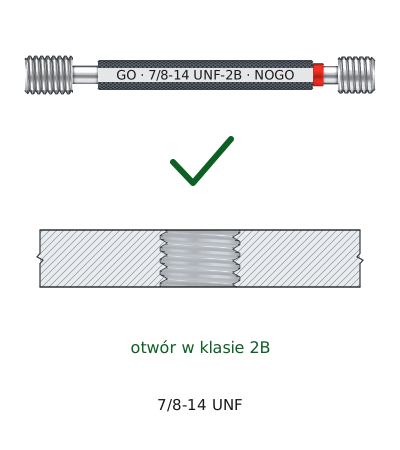
Class 2B confirmed
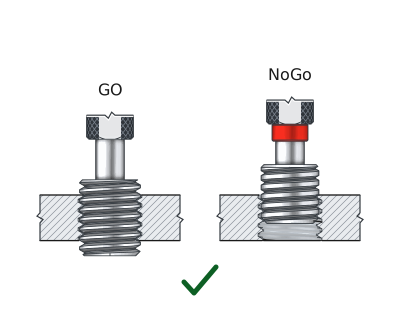
The GO end alone will accept a hole that is too loose; the NO-GO end alone will accept one that is too tight. Only both ends together bound the 0.178 mm tolerance zone.
Checks all thread characteristics at once and stops at 21.046 mm — the maximum material limit. It does not distinguish which characteristic has failed: profile, pitch, and diameter errors produce the same symptom.
Checks only the functional diameter at the minimum material limit, which is 21.224 mm. It may enter up to three full turns. The body may be stamped HI — the historical designation for the NO-GO end.
Comparison with classes 1B and 3B
All three classes start at the same point — the basic pitch diameter of 21.046 mm. They differ only in the upper limit, because an internal thread has no allowance.
| Class | D2 min [mm] | D2 max [mm] | Tolerance zone | Application | Status |
|---|---|---|---|---|---|
| 1B | 21.046 | 21.316 | 0.269 mm | Field assembly, threads exposed to contamination | |
| 2B | 21.046 | 21.224 | 0.178 mm | Commercial standard — nuts and tapped holes | THIS PRODUCT |
| 3B | 21.046 | 21.181 | 0.135 mm | Joints requiring repeatability |
A class 2B hole mates with class 1A, 2A, and 3A bolts — mixing classes is permitted. Class 2B is the default: unless the drawing specifies otherwise, this is the intended class.
Class 2B minor diameter range
| HOLE BEFORE TAPPING | |||
|---|---|---|---|
| Size | Value | Source | Note |
| Inch drill bit | 13/16 = 20.638 mm | inch drill chart | difficult to obtain in Poland |
| Metric drill bit | 20.500 mm | selected to fit the D1 range | recommended |
| Class 2B minor diameter D1 | 20.262 – 20.663 mm | ASME B1.1 | the hole must fall within this range |
At the same diameter of 22.225 mm, the coarse UNC series has 9 threads per inch and the fine UNF series has 14. The pitches are 2.822 and 1.814 mm. The nearest metric thread is M22, with a diameter of 22.000 mm — it differs from 7/8 inch by just 0.225 mm, so a shop caliper will not distinguish this pair.
The pitch is derived from the designation: 14 threads per inch means 25.4 divided by 14, or 1.814 mm. The basic pitch diameter is 22.225 − 0.6495 × 1.814 = 21.047 mm. This value is also the lower limit for class 2B, because an internal thread has no allowance.
The 13/16-inch drill measures 20.638 mm, while the upper minor diameter limit for class 2B is 20.663 mm. The margin is 0.025 mm — less than typical drill oversize. In practice, this means a thread that is too shallow. A 20.500 mm metric drill is used for this size, leaving a 0.163 mm margin.
What the gauge confirms and what it cannot measure
THE GAUGE CONFIRMS:
| ▸ | Confirms hole pitch diameter within 21.046 – 21.224 mm |
| ▸ | Checks profile and pitch together, using the GO end |
| ▸ | Detects an oversized thread, using the NO-GO end |
WHAT IT CANNOT MEASURE:
| ▸ | Hole minor diameter — this requires a separate plain plug gauge |
| ▸ | Thread depth in a blind hole |
| ▸ | Thread perpendicularity to the end face |
With a 20.500 mm metric drill. The 13/16-inch drill measures 20.638 mm and theoretically fits within the minor diameter range, but the margin below the upper limit is only 0.025 mm — any drill oversize takes the hole outside the tolerance. A 20.500 mm drill provides a 0.163 mm margin.
Yes. In the ORB and JIC systems, dash -10, intended for a 5/8-inch hose, has a 7/8-14 UNF thread. It is one of the most popular sizes in mobile hydraulics. Watch out for the metric M22 thread — the diameters differ by just 0.225 mm.
First check that there is no chip in the hole and that the first thread has not been rolled over. If the thread is clean but the plug still will not enter, the hole is too tight — usually because the drill was too small or the tap was dull and displaced material instead of cutting it. This thread can still be reworked with a finishing tap.
Each end bounds the tolerance zone on a different side. The GO end confirms that the thread is not too tight, but it will also enter a hole that is too loose. The NO-GO end works the other way around. Checking with only one end leaves half the tolerance unchecked, which is the most common error during thread acceptance inspection.

Reference: 0000006234 In stock > 10 items
€29.13 brutto
Reference: 15419 In stock < 10 items
€71.21 brutto
No customer reviews for the moment.
All orders are delivered by courier company GLS. For orders exceeding 369 PLN gross shipping is FREE
| Courier GLS | Przelew24 / Prepayment | 14,76 zł gross | Delivery time 1 working day |
| Courier GLS | Cash on delivery | 17,26 zł gross | Lead time 1 working day |
This website uses its own and third-party cookies to improve our services and show you advertising related to your preferences by analyzing your browsing habits. To give your consent to its use, press the Accept button.


