





- 98% satisfied customers
- 72h delivery
- 30 dni na zwrot

Description
THREAD3/4"-16 UNF
TOLERANCE2B
STANDARDASME B1.1
MATERIALTool steel
UNF 3/4-16 thread plug gauge — GO and NO-GO ends
Internal inch thread inspection according to ASME B1.1
| TECHNICAL DATA | |
|---|---|
| Thread type | Unified inch fine thread UNF |
| Thread size | 3/4-16 |
| Threads per inch | 16 TPI |
| Thread pitch | 1.587 mm |
| Nominal diameter | 19.050 mm |
| Tolerance class | 2B |
| Pitch diameter D2 | 18.019 – 18.184 mm |
| Hole minor diameter D1 | 17.330 – 17.689 mm |
| Gauge type | Double-ended: GO + NO-GO |
| Material | Tool steel, hardened |
| Hardness | 58-62 HRC |
| Standard | ASME B1.1 / ASME B1.2 |
| Manufacturer | Varel |
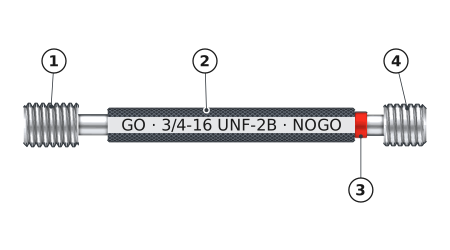
1
GO end — longer thread with a full profile. It is screwed in by hand through the full length of the hole.
2
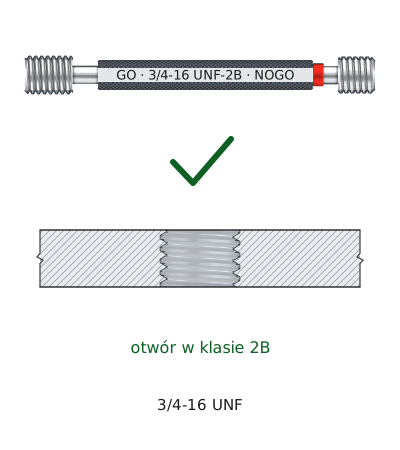
Handle engraved with 3/4-16 UNF-2B — size and tolerance class of the hole being inspected.
3
Red ring — identifies the NO-GO end.
4
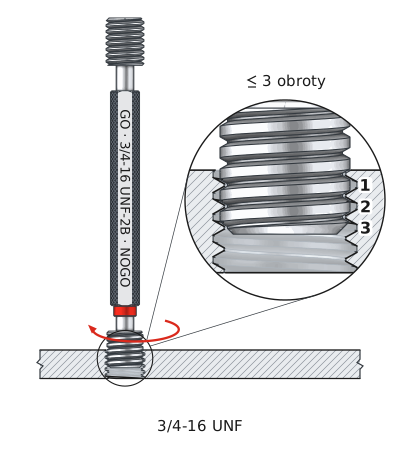
NO-GO end — shorter thread with a truncated profile. It checks only the pitch diameter, so it may engage no more than 3 turns.
UNF 3/4-16 thread plug gauge checks an internal thread — a tapped hole or nut. The GO end must screw in by hand through the full thread depth; the NO-GO end may enter no more than three full turns according to ASME B1.2. The metric rule in ISO 1502 specifies two threads and does not apply here.
The three-quarter-inch fine thread is used on a dash -8 JIC hydraulic fitting — one of the most popular sizes in hydraulic power systems, alongside dash -6 and dash -10. An ORB O-ring port of the same size has the same thread. In aviation, it corresponds to the AN12 bolt.
Hole inspection in three steps
Internal thread acceptance criterion according to ASME B1.2
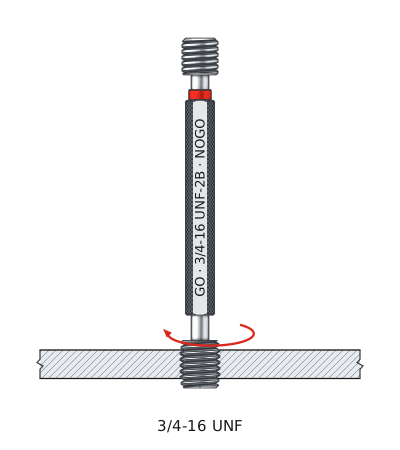
1
The GO end is screwed in by hand, without force, along the full length of the 3/4-16 UNF thread.
2
The NO-GO end stops within 3 full turns, without forcing.
3
The GO end passed and the NO-GO end stopped — the hole meets class 2B.
Thread inspection in 3 steps
1 GO end (passing)
Screwed in by hand — enters to the full depth
2 NO-GO end
Screwed in by hand — no more than 3 full turns
✓ Acceptable thread
Class 2B confirmed
Both conditions must be met simultaneously. At a pitch of 1.587 mm, the three permitted turns of the NO-GO end give a depth of 4.761 mm.
GO end (passing)
Represents the hole's maximum material condition — the minimum permissible pitch diameter of 18.019 mm. Checks profile, pitch, and diameter simultaneously, because an error in any of these features reduces the functional diameter and stops the plug.
NO-GO end
Represents the least material condition — the maximum permissible pitch diameter of 18.184 mm. Detects an oversized threaded hole in which the joint will loosen. The body may be stamped HI, the historical designation for the NO-GO end.
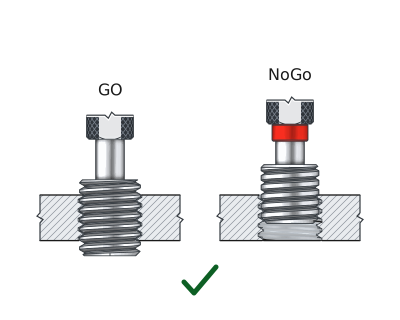
✓ Thread acceptable — GO enters the full length, NO-GO stops.
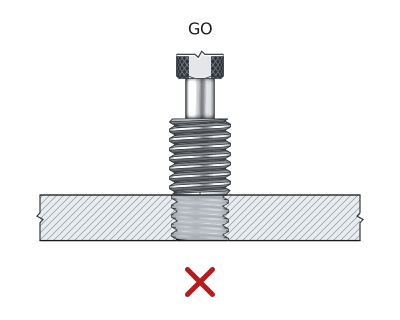
✗ Thread too tight — GO does not enter the hole.
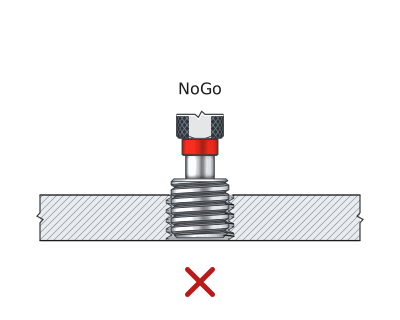
✗ Thread too loose — the NO-GO end enters more than 3 turns.
Tap drill for 3/4-16 and the hole tolerance range
How to determine the hole size to drill
| HOLE BEFORE TAPPING | |||
|---|---|---|---|
| Size | Value | Source | Note |
| Inch drill bit | 11/16 = 17.463 mm | inch drill chart | difficult to obtain in Poland |
| Metric drill bit | 17.500 mm | selected to fit the D1 range | recommended |
| Class 2B minor diameter D1 | 17.330 – 17.689 mm | ASME B1.1 | the hole must fall within this range |
At the same diameter of 19.050 mm, the coarse UNC series has 10 threads per inch and a pitch of 2.540 mm, while the fine UNF series has 16 threads per inch and a pitch of 1.587 mm. The difference is clear on a thread pitch gauge. The metric M20 thread, with a diameter of 20.000 mm, is harder to distinguish — they differ by 0.950 mm, but this is not visible at all in a hole contaminated with hydraulic oil.
The pitch is derived from the designation: 16 threads per inch means 25.4 divided by 16, or 1.587 mm. The basic pitch diameter is 19.050 − 0.6495 × 1.587 = 18.019 mm. This value is also the lower limit for class 2B, because an internal thread has no allowance.
Classes 1B, 2B, and 3B for size 3/4-16
Why this gauge is class 2B
Comparison of internal thread classes
All three classes start at the same point — the basic pitch diameter of 18.019 mm. They differ only in the upper limit, because an internal thread has no allowance.
| Class | D2 min [mm] | D2 max [mm] | Tolerance zone | Application | Status |
|---|---|---|---|---|---|
| 1B | 18.019 | 18.268 | 0.249 mm | Field assembly, threads exposed to contamination | |
| 2B | 18.019 | 18.184 | 0.165 mm | Commercial standard — nuts and tapped holes | THIS PRODUCT |
| 3B | 18.019 | 18.143 | 0.124 mm | Joints requiring repeatability |
A class 2B hole mates with class 1A, 2A, and 3A bolts — mixing classes is permitted. Class 2B is the default: unless the drawing specifies otherwise, this is the intended class.
▲
Caution: inch threads in a European machine
Construction machinery assembled in Europe often has mixed hydraulic systems — a body with metric ports and lines with inch fittings, or vice versa. Screwing an M20 metric fitting into a 3/4-16 UNF port causes the thread in the body to gall, resulting in the most expensive repair possible. Before assembly, determine the thread by measurement, not from a catalog.
Inspection scope and storage
What the gauge confirms and what it cannot measure
THE GAUGE CONFIRMS:
| ▸ | Confirms hole pitch diameter within 18.019 – 18.184 mm |
| ▸ | Checks profile and pitch together, using the GO end |
| ▸ | Detects an oversized thread, using the NO-GO end |
WHAT IT CANNOT MEASURE:
| ▸ | Hole minor diameter — this requires a separate plain plug gauge |
| ▸ | Thread depth in a blind hole |
| ▸ | Thread perpendicularity to the end face |
Frequently asked questions
Yes. In the 37° JIC system per SAE J514, dash -8 has a 3/4-16 UNF thread; the same thread is used in an ORB O-ring port of this size. However, the dash number specifies the tube diameter, which is half an inch, rather than the thread diameter — specify the thread size when ordering.
No. The diameters differ by 0.950 mm and the pitches by almost a millimeter — 1.587 mm for the inch thread versus 2.500 mm for M20. Forcing a metric fitting into the port will gall the thread in the body. In mixed hydraulic systems, always verify the thread by measurement.
Two different standards apply. Inch threads are inspected according to ASME B1.2, section 4.2.1, which permits three full turns of the NO-GO end. Metric threads are covered by ISO 1502, with a limit of two threads. Applying the rule from one system to the other results in rejecting good parts or accepting defective ones.
No. The letter determines whether the gauge is intended for a hole or a bolt. B denotes an internal thread, which is what this plug gauge checks; A denotes an external thread, which requires a thread ring gauge. Ordering a class 2A thread plug gauge makes no sense, yet such orders are placed.
Product accessories


Thread ring gauge UNF 3/4-16 2A GO NO-GO
Reference: 15418 In stock < 10 items
€52.63
€64.74 brutto
Reviews
No customer reviews for the moment.
Shipping
All orders are delivered by courier company GLS. For orders exceeding 369 PLN gross shipping is FREE
| Courier GLS | Przelew24 / Prepayment | 14,76 zł gross | Delivery time 1 working day |
| Courier GLS | Cash on delivery | 17,26 zł gross | Lead time 1 working day |
Recommended for you


This website uses its own and third-party cookies to improve our services and show you advertising related to your preferences by analyzing your browsing habits. To give your consent to its use, press the Accept button.
Cookie preferences
Functional cookiesTechnical
Functional cookies are strictly necessary to provide the services of the shop, as well as for its proper functioning, so it is not possible to refuse their use. They allow the user to browse through our website and use the different options or services that exist on it.
Advertising Cookies
These are cookies that collect information about the advertisements shown to users of the website. They can be anonymous, if they only collect information about the advertising spaces shown without identifying the user, or personalised, if they collect personal information about the user of the shop by a third party, for the personalisation of these advertising spaces.
Analytics cookies
Collect information about the user's browsing experience in the shop, usually anonymously, although sometimes they also allow the user to be uniquely and unequivocally identified in order to obtain reports on the user's interests in the products or services offered by the shop.